Transcendence Splashes Down

Nasa
It is objectively no small feat, slipping the surly bonds of Earth. But somehow, over its 30 years of existence, NASA’s Space Shuttle program has become roughly as thrilling as the Delta Shuttle. Still, there’s something sad about the end of the program, which will officially shut down after Endeavour’s 25th and final mission, on April 29, and one last there-and-back by Space Shuttle Atlantis in June. It’s not so much that the program’s increasingly prosaic missions—they have amounted, in recent years, to something like space carpooling—will be missed. The sadness instead comes from the petering out of space travel’s promised transcendence.

The commonplace marvels of modern technology probably have something to do with this awe deficit—a 400-mile vertical round-trip in a less-than-sleek 1992-model vehicle may not seem as miraculous as it did in a time before one could, if booked on the right airline, stream Parks and Recreation onto an iPad mid-flight. The Shuttle program’s geopolitical moment has passed, too. We’re no longer going to space to prove that our way of life is superior to an evil empire’s; instead, we’re going up there to do some repairs, drop off a magnetic spectrometer, and see the sights. And with deficits suddenly the Greatest Threat Our Nation Has Ever Faced, such errands now stand out as a sore thumb of a line item. The Space Shuttle program has cost nearly $200 billion over its lifetime; at a moment when we’re cutting holes in the social safety net to try to balance the books, Friday’s Shuttle launch will cost what NASA says is nearly half a billion dollars and another estimate puts at $1.2 billion. That the “economic, scientific and technological returns of space exploration have far exceeded the investment,” as former NASA life-sciences director Joan Vernikos has written, makes the accounting look a little more favorable, of course. But simply talking about it that way suggests just how un-wonderful space has become.

Read More

A Rose of Galaxies? NASA Rings In Hubble's 21st Birthday

Nasa rose
If space-based telescopes could tipple, they probably wouldn't need to--not with images like the one above on tap. NASA's celebrating the Hubble Space Telescope's 21st birthday (hey, it's legal!) with an image that almost resembles starry petals on some vast and distant heavenly rose.

You're in fact staring at a shot of two galaxies in an interstellar tete-a-tete, in which one (dubbed UGC 1810) is being persuaded by another (dubbed UGC 1813) to “blossom." The two galaxies exert gravitational forces on each other that warp their shapes, culminating in the rose-like appearance of UGC 1810. There's even a slender “tidal bridge” of matter slung between both galaxies--separated by “tens of thousands” of light years--like an intergalactic zip line.

Call the whole thing “Arp 273,” because NASA does, and it's located in the constellation Andromeda, about 300 million light-years distant from us.

As for the Hubble itself, my first memories when it launched back in April 1990 are probably the same as yours: it couldn't "see" clearly due to a flawed mirror. The servicing mission that eventually fixed it didn't occur until December 1993, incidentally the most complex mission ever undertaken at that point, and one in which astronauts were trained in the use of over 100 instruments to repair and fine tune things.

"Hubble is America's gift to the world," said Sen. Barbara Mikulski of Maryland in a NASA statement. "Its jaw-dropping images have rewritten the textbooks and inspired generations of schoolchildren to study math and science. It has been documenting the history of our universe for 21 years. Thanks to the daring of our brave astronauts, a successful servicing mission in 2009 gave Hubble new life. I look forward to Hubble's amazing images and inspiring discoveries for years to come."

Read more:

NASA clears shuttle Endeavour for April 29 launch

Endeavour
The shuttle Endeavour was cleared for a launch attempt on April 29 to deliver a new class of physics instrument to the International Space Station on NASA's next-to-last shuttle flight, officials said Tuesday.

Liftoff of the 134th shuttle mission is scheduled for 3:47 p.m. EDT from the Kennedy Space Center in Florida.

The all-veteran crew is led by Mark Kelly, husband of Arizona Democratic Representative Gabrielle Giffords, who is recovering from a January 8 shooting that killed six people and injured 12 others.

Pending approval from her doctors, Giffords, who has not been seen publicly since the attack outside a Tucson, Arizona, grocery store, plans to attend the launch, Kelly has said.

The primary purpose of the flight is to deliver the $2 billion Alpha Magnetic Spectrometer, or AMS, particle detector, an instrument designed to detect dark matter, antimatter and other exotic phenomena.

"It has the potential of returning really Earth-shattering science," said NASA's Bill Gerstenmaier.

A team of 600 scientists from 16 nations, including China and Taiwan, are partners in the project.

After installing AMS the Endeavour astronauts will turn their attention to four spacewalks and other tasks to help get the space station ready for operations without shuttle support. The station is a $100 billion project of the United States, Russia, Europe, Japan and Canada that has been under construction since 1998, 220 miles above Earth.

Read More

NASA awards $270M to spacecraft builders

Nasa
NASA on Monday awarded almost $270 million to developers of four U.S. spacecraft that are the frontrunners to fly astronauts after the shuttle.

Two capsules, a space plane and a gumdrop-shaped spacecraft were selected under a program seeking to develop commercial vehicles to taxi astronauts to the International Space Station or other destinations by the middle of the decade.

After two more shuttle flights, NASA will rely on Russian spacecraft for rides to the space station until a U.S. commercial service becomes available.

"We're committed to safely transporting U.S. astronauts on American-made spacecraft and ending the outsourcing of this work to foreign governments," NASA Administrator Charles Bolden said in a statement. "These agreements are significant milestones in NASA's plans to take advantage of American ingenuity to get to low-Earth orbit, so we can concentrate our resources on deep space exploration."

NASA hopes privately run crew transportation will cost less than a government-run system, allow the agency to focus on building a giant rocket and capsule for exploration and help spur a market for commercial spaceflight.

Read More

Final Landings for NASA’s Space Shuttles — and some planning thoughts

Space shuttle landing
The news of the decision was made last week. Fierce competition for the three remaining Space Transport System (STS) vehicles — “Space Shuttles” in non NASA speak — which have been in orbit, as well as the engineless Enterprise which flew in Earth’s atmosphere but not designed for orbital missions — was had though the cost to each museum would be high. Estimated costs are around $28 million USD to render each shuttle safe for public display and transport with the added hefty requirement to display the each shuttle indoors.

Here are the locations with some added thoughts:

STS Atlantis will go to the Kennedy Space Center (KSC) in Cape Canaveral, Florida. I am not sure if the existing buildings there will house her, or not. Getting Atlantis to KSC will be easy as she has been routinely flown there in order to accomplish her missions but getting her to the display site will need some attention.

STS Discovery is destined for the National Air & Space Museum Steven F Udvar-Hazy Center in Chantilly, Virginia near Washington DC. This museum is the current home for STS Enterprise which will be transported to the Intrepid Sea, Air & Space Museum in New York City, New York. The Udvar-Hazy Center is located in the southeastern corner of Dulles International Airport and the design of the museum reflects that of an extremely large aircraft hangar. Extracting the Enterprise and inserting the Discovery should be a straight forward affair though one that would be interesting to watch. Dulles may experience a unique event, NASA’s shuttle carrying Boeing B-747 landing with one shuttle and taking off with another.

STS Endevour has been slated to retire to the California Science Center in Los Angeles, California. This museum has a Lockheed A-12 “Blackbird” nicknamed individually”Titanium Goose”* on outside display along with a Douglas DC-8 also on outside display. The museum is not on an airfield — getting the Endevour to LAX will be easy enough to accomplish but taking her over 10 miles (16km) of urban roadways will be challenging and a new building will be required.

Read More

Next Generation Space Telescope

Nasa Telescope
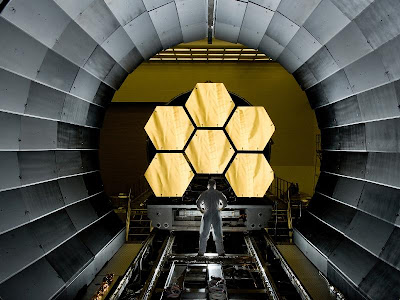
NASA engineer Ernie Wright looks on as the first six flight ready James Webb Space Telescope's primary mirror segments are prepped to begin final cryogenic testing at NASA's Marshall Space Flight Center.

This represents the first six of 18 segments that will form NASA's James Webb Space Telescope’s primary mirror for space observations. Engineers began final round-the-clock cryogenic testing to confirm that the mirrors will respond as expected to the extreme temperatures of space prior to integration into the telescope's permanent housing structure.

Read More

Father of Mission Control honored by NASA

Chris kraft
For more than four decades, building 30 at NASA’s Johnson Space Center has been home to Mission Control. It still is, but on Thursday it took on a new name to honor the “father of Mission Control,” Christopher C. Kraft Jr.

Kraft began his space flight career soon after graduating from Virginia Tech University in 1944 with the National Advisory Committee for Aeronautics, NASA’s predecessor agency.

In 1958 he volunteered for the Space Task Group, the organization charged with creating what is NASA today.

The group created the first flight manuals and developed the procedures for the operation of a never-before concept, a central control center.

New concept

“A control center was a new idea,” former Gemini and Apollo program flight director and Kraft protégée Glynn Lunney said during ceremonies in front of the mission control center. “Whenever there was a picture of a control center, it was ours. And now I don’t think you can go into a building that people don’t have a control center in it. What you see behind us is a pretty big building, but it’s not so much the building, the concrete and the consoles, it’s the idea behind it.

“This represents a pretty profound idea and Chris brought it to us.”

Read More

Budget pessimism may drive JWST launch date to 2018

NASA
Struggling to match schedules with bleak funding realities, NASA and contractor officials say launch of the troubled James Webb Space Telescope could be delayed to 2018, four years later than the date NASA publicly pronounced last fall.
Testifying before a U.S. Senate subcommittee Monday, NASA Administrator Charles Bolden said the agency is still completing a bottoms-up assessment of the next-generation space observatory before announcing a specific launch readiness date and cost projections.

Sen. Barbara Mikulski, D-Md., asked Bolden how much money is needed to put JWST back on track, saying lawmakers need realistic numbers to incorporate into the federal budget process.

Mikulski is the chair of the commerce, justice and science subcommittee of the Senate Appropriations Committee.

Read More

Who Will Get Shuttles? NASA Naming Winners Tuesday

Nasa
NASA will be announcing where the retiring space shuttles will go on display once the program ends this summer.

Twenty-one museums and centers around the country put in bids for the spaceships. NASA is disclosing the winners Tuesday on the 30th anniversary of the first space shuttle launch in 1981.

The shuttle program is winding down with only two more flights left. Shuttle Discovery ended its flying career last month and it's going to the Smithsonian Institution in Washington.

Up for grabs are shuttles Endeavour and Atlantis and the prototype Enterprise.

Some of the hot contenders are visitor centers at Kennedy Space Center and Johnson Space Center, the Air Force Museum in Ohio and museums in New York City, Seattle and Chicago.

Read More

NASA's Jupiter-Bound Spacecraft Arrives in Florida

Nasa
NASA's Juno spacecraft has arrived in Florida to begin final preparations for a launch this summer. The spacecraft was shipped from Lockheed Martin Space Systems, Denver, to the Astrotech payload processing facility in Titusville, Fla., on April 8, 2011. The solar-powered Juno spacecraft will orbit Jupiter's poles 33 times to find out more about the gas giant's origins, structure, atmosphere and magnetosphere.

"The Juno spacecraft and the team have come a long way since this project was first conceived in 2003," said Scott Bolton, Juno's principal investigator, based at Southwest Research Institute in San Antonio. "We're only a few months away from a mission of discovery that could very well rewrite the books on not only how Jupiter was born, but how our solar system came into being."

On April 11, Juno will be removed from its shipping container, the first of the numerous milestones to prepare it for launch. Later that week, the spacecraft will begin functional testing to verify its state of health after the road trip from Colorado. After this, the team will load updated flight software and perform a series of mission readiness tests. These tests involve the entire spacecraft flight system, as well as the associated science instruments and the ground data system.

Juno will be carried into space aboard a United Launch Alliance Atlas V rocket lifting off from Launch Complex-41 at the Cape Canaveral Air Force Station in Florida. The launch period opens Aug. 5, 2011, and extends through Aug. 26. For an Aug. 5 liftoff, the launch window opens at 8:39 a.m. PDT (11:39 am EDT) and remains open through 9:39 a.m. PDT (12:39 p.m. EDT).

Read More

Expedition 27 Resumes Busy Schedule With New Crew Members


The six-member Expedition 27 crew is back to work after docking activities on Wednesday and an off-duty day Thursday. They reviewed roles, responsibilities and emergency procedures and conducted the usual complement of science and maintenance activities. New flight engineers Alexander Samokutyaev and Andrey Borisenko were busy inside the Russian segment of the International Space Station. Samokutyaev worked on a science experiment that measures radiation inside the orbital laboratory. Borisenko unloaded cargo from the newly docked Soyuz TMA-21 spacecraft. Flight Engineer Ron Garan, who also joined Expedition 27 on Wednesday night, worked in the American side of the space station. Garan checked out the Water Processing Assembly in the Destiny laboratory and worked on cooling loops in the Columbus laboratory.

NASA spacecraft join in cosmic observation

cosmic observation
NASA says three of its orbiting spacecraft have teamed up to study a puzzling cosmic blast of energy, one that has lasted more than a week.

The Swift Gamma Burst Mission spacecraft, the Hubble Space Telescope and the Chandra X-ray Observatory have been observing a phenomenon scientists say is brighter, longer-lasting and more variable than anything they've seen before, a NASA release said Thursday.

Astronomers say the unusual blast is likely the result of a star wandering too close to its galaxy's central black hole where intense gravitation tidal are tearing the star apart, and the in-falling gas is streaming toward the hole.

The model suggests the spinning black hole has formed an outflowing jet of X-rays and gamma rays along its rotational axis that is pointed in our direction.

"The best explanation at the moment is that we happen to be looking down the barrel of this jet," said Andrew Levan at the University of Warwick in the United Kingdom, who led the Chandra observations.

Read more:

Russian Soyuz spacecraft docks at International Space Station

ISS
Russian Soyuz Commander Alexander Samokutyayev, NASA Flight Engineer Ron Garan and cosmonaut Andrey Borisenko joined three other crew members on the International Space Station.

It was the first time in space for Russians Samokutyayev and Borisenko. The Soyuz launch on April 6 came less than a week before the 50th anniversary of Yuri Gagarin's historic flight from the same, once secret Baikonur launch facility to become the first human in orbit.

The successful launch of the Soyuz spacecraft will likely ease concerns over reliance on the single-use Russian spacecraft as NASA mothballs its shuttle fleet later this year.

Lift off had been postponed from March 30 due to a glitch in the upgraded Soyuz's communication system.

The three men will spend six months aboard the station conducting about 40 experiments as part of the 100 billion dollar project.

Read More

NASA delays shuttle

NASA Shuttle
The 25th and final flight of shuttle Endeavour will slip 10 days to April 29, clearing the way for the previously scheduled launch of a robotic Russian space freighter and its arrival at the International Space Station.

The high-profile shuttle mission, commanded by the husband of critically wounded U.S. Rep. Gabrielle Giffords, coincidentally will take place the same day as the royal wedding of Prince William and Kate Middleton.

"Somehow I don't think that factored into (shuttle launch date) planning," said Allard Beutel, a spokesman for NASA's Kennedy Space Center. "It is what it is."

Endeavour and six astronauts aim to deliver a $2 billion cosmic ray detector that could shed new light on the origin, evolution and fate of the universe.

There has been a high level of human interest in the mission because Giffords, who was shot in the head during a Jan. 8 assassination attempt, is making a remarkable recovery and hopes to attend the launch.

Read More

Scientists ponder sun's next move from quiet phase

Sun
Could a cooler sun, which some solar astronomers now predict, save us from global warming?

The short answer is "no," scientists say.

"That would be convenient and would make a lot of people happy," said Greg Kopp, a physicist with the Laboratory for Atmospheric and Space Physics at the University of Colorado.

Kopp notes that the sun has been in a quiet phase during the last decade's rise in global temperatures.

"Human-caused climate effects are far outweighing the solar effects currently," said Kopp, who is an instrument scientist for a NASA satellite that measures the sun's heat output, or total solar irradiance.

Satellites have measured the sun's radiation at the point where it reaches Earth's atmosphere for 32 years. The average difference between energy at the peak and minimum of solar cycles is less than 0.1 percent.

That flux is easily absorbed and balanced by the Earth's oceans, Kopp said, and has a minimal effect on the Earth's temperature.

Read More

Villagers’ son prepares for historic space shuttle launch, shares details in NASA press conference


Two years ago, Village of Duval residents Steve and Beth Feustel stood witness as their son Andrew prepared for his inaugural voyage into space.

Soon, Andrew Feustel will return to space, this time serving as lead spacewalker during Space Shuttle Endeavour’s

STS-134 mission to the International Space Station. According to NASA, the mission’s targeted launch date is April 19 from Kennedy Space Center.

During a Thursday morning press conference held at KSC, Feustel and the rest of Endeavour’s crew shared their thoughts on the upcoming mission, the preparations that are now under way and their activity since arriving at KSC on Tuesday evening.

During the mission, crew members will be delivering the Alpha Magnetic Spectrometer-2 to the International Space Station, according to NASA.

Space shuttle Commander Mark Kelly described the AMS as “one of the premier science experiments of the 21st century.”

Information from NASA explains that the AMS searches for “various types of unusual matter by measuring cosmic rays.”

“We are pretty excited with what the results are going to be,” Kelly said, explaining that the AMS “could be teaching us things about the universe that are completely unexpected.”

Feustel is well prepared to tackle the challenge. Upon introducing each of his crew members, Kelly noted Feustel’s previous spacewalks during Space Shuttle Atlantis’

STS-125 mission to make repairs to the Hubble Space Telescope.

Read More
NASA Satellites Detect Extensive Drought Impact on Amazon Forests


A new NASA-funded study has revealed widespread reductions in the greenness of the forests in the vast Amazon basin in South America caused by the record-breaking drought of 2010."The greenness levels of Amazonian vegetation - a measure of its health - decreased dramatically over an area more than three and one-half times the size of Texas and did not recover to normal levels, even after the drought ended in late October 2010," said Liang Xu, the study's lead author from Boston University.

The drought sensitivity of Amazon rainforests is a subject of intense study. Scientists are concerned because computer models predict that in a changing climate with warmer temperatures and altered rainfall patterns the ensuing moisture stress could cause some of the rainforests to be replaced by grasslands or woody savannas. This would cause the carbon stored in the rotting wood to be released into the atmosphere, which could accelerate global warming. The United Nations' Intergovernmental Panel on Climate Change (IPCC) has warned that similar droughts could be more frequent in the Amazon region in the future.The comprehensive study was prepared by an international team of scientists using more than a decade's worth of satellite data from NASA's Moderate Resolution Imaging Spectroradiometer (MODIS) and Tropical Rainfall Measuring Mission (TRMM).

NASA Extends Contract for Supercomputing Support Services

nasa super computer
NASA will exercise the third one-year option on a contract with Computer Sciences Corp. in Lanham, Md., to provide supercomputing support services at NASA's Ames Research Center at Moffett Field, Calif. The option is valued at approximately $58.6 million.

The option exercised on the cost-plus-award-fee contract begins April 1 and continues until March 31, 2012. The contract consists of a two-year base period, which began Aug. 1, 2007, and eight one-year priced options with a maximum value of approximately $597 million if all options are exercised.

The company will continue to support supercomputing services provided by the agency's primary high performance computing facility operated by the NASA Advanced Supercomputing Division at Ames. The facility serves as the supercomputing pathfinder for the agency and develops and operates some of the largest, most advanced and productive supercomputers in the world.

The contract is structured so the company also may provide supercomputing services to the NASA Center for Computational Sciences facility at NASA's Goddard Space Flight Center in Greenbelt, Md., and additional high performance computing support to other agency field centers as needed.

Read More

NASA Dismantling Discovery For Retirement

NASA
Piece by piece, workers are removing parts from the space shuttle Discovery to prepare it for its life after spaceflight.

Discovery completed its 39th and final mission this month.

This week, NASA workers are removing the forward reaction control system in preparation for the shuttle's display.

The system's plumbing contains deadly rocket fuel.

When the shuttles are put on display, they will have mocked-up or space engines and will look complete. Only the workers will know what's gone.

NASA Administrator Charlie Bolden is expected to decide in April where the retired shuttles will be displayed.

Read More
NASA’s Space Shuttle Train Is Basically A Giant, Moving Bomb


NASA’s Space Shuttle Train Is Basically A Giant, Moving Bomb but it’s actually very safe! And yes, NASA has a railroad. It’s been around since 1963, actually—so apologies to space nuts who’ve known about it for a while—but only recently has the agency uploaded an expose to YouTube.


Seriously, though, this train takes huge, volatile rocket booster segments and fuel from Utah to the Kennedy Space centre on specialised railroad cars, and has been doing so since 1963. It’s been upgraded since then, of course, but the goal remains the same: Take those boosters and fuel from where they’re processed, refitted, fixed and manufactured, and get them to the launch pad in Florida.

Sadly, the last rocket load was moved in May 2010, in preparation for the final space shuttle flights (beginning with Discovery earlier this month). That said, the railroad will continue to serve NASA in other ways, officials say in the video, which we hope to mean future manned and un-manned space missions.

Read More

NASA proposes solar power project at Wallops Flight Facility in Va

nasa
NASA is proposing to install solar panels at its Wallops Flight Facility on Virginia's Eastern Shore.

The agency says it is proposing up to 80 acres of solar panels that would be capable of generating 10 gigawatt-hours per year of electricity.

The project would generate renewable electricity to help NASA meet or exceed requirements of the 2005 Federal Energy Policy Act and other executive orders. The project also would be expected to stabilize Wallops' growing utility costs and provide educational outreach regarding renewable energy technologies.

In addition, two 2.4 kilowatt residential-scale wind turbines would be installed around the facility.

NASA says the project in total would generate enough electricity in a year to power 850 average American homes.

Read More

NASA's Successful 'Can Crush' Will Aid Heavy-Lift Rocket Design


In this week, NASA put the squeeze on a large rocket test section. Results from this structural strength test at NASA's Marshall Space Flight Center in Huntsville, Ala., will help future heavy-lift launch vehicles weigh less and reduce development costs.This trailblazing project is examining the safety margins needed in the design of future, large launch vehicle structures. Test results will be used to develop and validate structural analysis models and generate new "shell-buckling knockdown factors" -- complex engineering design standards essential to launch vehicle design.

"This type of research is critical to NASA developing a new heavy-lift vehicle," said NASA Administrator Charlie Bolden. "The Authorization Act of 2010 gave us direction to take the nation beyond low-Earth orbit, but it is the work of our dedicated team of engineers and researchers that will make future NASA exploration missions a reality."

The aerospace industry's shell buckling knockdown factors date back to Apollo-era studies when current materials, manufacturing processes and high-fidelity computer modeling did not exist. These new analyses will update essential design factors and calculations that are a significant performance and safety driver in designing large structures like the main fuel tank of a future heavy-lift launch vehicle.During the test, a massive 27.5-foot-diameter and 20-foot-tall aluminum-lithium test cylinder received almost one million pounds of force until it failed. More than 800 sensors measured strain and local deformations. In addition, advanced optical measurement techniques were used to monitor tiny deformations over the entire outer surface of the test article.

NASA Opens New Rocket Facility in Virginia


ASA has start a new facility to help ready commercial rockets for launch, and the first work at the new site should begin this month in preparation for a test flight to the International Space Station later this year.

The space agency held a ribbon-cutting ceremony on march 22, attended by bigwigs such as NASA Administrator Charles Bolden and Sen. Barbara Mikulski, D-Md. — to christen the new Horizontal Integration Facility (HIF) at its Wallops Flight Facility on Wallops Island, Va.

The facility is six stories tall, about 250 feet (76 meters) long and 150 feet (49 m) wide. Medium-class rockets with multiple stages will be assembled at the HIF, then rolled out for launch at a nearby Wallops pad. NASA's first customer for the new rocket facility is Virginia-based Orbital Sciences, which will use the new building to assemble its Taurus 2 rocket — a vehicle that is expected to begin launching supply runs to the space station for NASA in 2012.

NASA wishes Shatner happy 80th

nasa
NASA joined the throngs of fans wishing "Star Trek" actor William Shatner a happy 80th birthday Tuesday in the form of an online note to TV's original Capt. James T. Kirk.

"We want to wish happy birthday to @WilliamShatner — someone who continues to boldly go!" NASA told Shatner via Twitter, where the space agency posts updates as @NASA.

Shatner starred as the iconic captain of the starship Enterprise in the original "Star Trek" science fiction series that ran from 1966 to 1969. He reprised the role in seven of the franchise's 11 feature films.

To mark Shatner's birthday, the actor's website teamed up with TrekMovie.com and ThinkGeek for an online video contest for "International Talk Like William Shatner Day." The winner for best video will receive a gold command-color Star Trek robe.

Read More

Toyota Plaintiffs Challenge NASA Sudden-Acceleration Report

nasa
Lawyers representing hundreds of people suing Toyota Motor Corp. (7203) over incidents of sudden acceleration challenged a NASA report that found electronic flaws weren’t the cause of problems that resulted in the recall of thousands of vehicles.

Plaintiffs’ experts will contradict the findings in the NASA report, conducted for the National Highway Traffic Safety Administration, and will prove Toyota’s electronic throttle control system is the cause of sudden acceleration, lawyers said in court papers filed last week in Santa Ana, California, Federal Court.

Toyota, based in Toyota City, Japan, urged U.S. District Judge James V. Selna to take judicial notice of the findings. The NASA conclusions could then be used by Toyota as factually true during trials that are scheduled to begin in 2013.

“Toyota asks this court to take judicial notice of findings and conclusions by NASA and NHTSA that are hotly disputed in this litigation,” Steve Berman, the plaintiffs’ lawyer, wrote. “If this court took judicial notice of the disputed findings and conclusions, plaintiffs would be barred from challenging them in this litigation.”

NASA concluded in the Feb, 8 report that incidents of unintended sudden acceleration in Toyota vehicles were rooted in mechanical flaws such as sticking accelerator pedals and floor mats that jammed the pedals or were caused by driver error.

Read more

See Mercury in 3D

Mercury
Going to the cinemas these days offer us an option – to watch a movie in 3D or not? Well, NASA’s MESSENGER has started to orbit the planet at 01:45 CET, where this little transport that could will carry the necessary scientific instruments required to map Mercury from a distance, analyzing the structure and composition of its surface in the process while creating what some might call a 3D model in the end. Scientists at the German Aerospace Center (Deutsches Zentrum fur Luft- und Raumfahrt; DLR) will be the brains that analyze collected data from three of the instruments on the MESSENGER. Being the smallest among the terrestrial planets, Mercury is still a huge mystery since it possesses an unusually high density with an interior that comprises of an iron core surrounded by a thin rocky mantle and crust. You won’t need to wear a dorky pair of 3D glasses to see the planet in 3D glory, that’s for sure.

Read More

NASA Holds Information Technology Summit In August

Nasa
NASA's second Information Technology Summit will bring together government and industry leaders to provide the latest perspectives on the IT field. The summit will take place August 15-17 at the Marriott Marquis Hotel in San Francisco.

Approximately 2,000 participants from NASA mission directorates and support organizations, private industry, academic institutions, other federal agencies and IT groups are expected to attend. The event will feature more than 100 speakers and panel discussions on topics including best practices, enterprise architecture, innovative social networking, open government, and IT security and privacy.

NASA has partnered with the non-profit National Institute of Aerospace for the event. The institute acts as a liaison among NASA, industry, public partners and academia to secure resources to better promote the agency's vision while enabling an open dialogue among a broad IT community.

NASA Associate Administrator and Chief Information Officer Linda Cureton will host the event. "The Information Technology Summit continues NASA's goal of inspiring a more innovative, collaborative, and informed IT workforce and bringing together America's IT talent to one location through technical workshops and information exchange," Cureton said.

Read More

Nasa's Messenger probe orbits Mercury

nasa
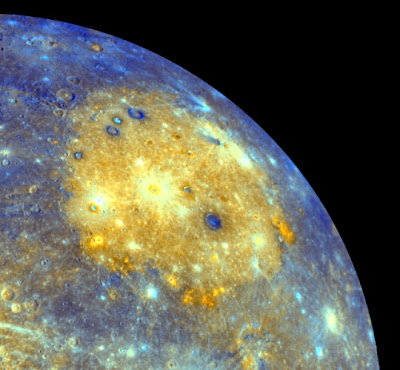
Mercury isn't really blue and gold. "In general," says Nasa, "in light visible to the human eye, Mercury's surface shows only very subtle colour variations."

The space agency explains how it extrapolates colourful images such as the one above. When images from all 11 narrow-band colour filters of the Wide Angle Camera in the Mercury Dual Imaging System "are statistically compared and contrasted, these subtle colour variations can be greatly enhanced, resulting in extremely colourful representations of Mercury's surface", Nasa says.

In this (cropped) mosaic of what Nasa calls the "eastern limb" of Mercury, from the flyby in January 2008 (the first of the three by Messenger), the large gold-hued circular area is the Caloris basin, notable for its volcanic plains. The basin is about 960 miles in diameter. Messenger passed by at a distance of around 8,000 miles.

Read More

NASA unpacks humanoid robot in space

nasa gabby
The first humanoid robot ever launched into space is finally free. Astronauts at the International Space Station unpacked Robonaut on Tuesday, about two weeks after its arrival via shuttle Discovery. NASA broadcast the light-hearted unveiling ceremony yesterday.

American Catherine Coleman and Italian Paolo Nespoli pried off the lid of the robot’s packing box, as though they were opening a coffin. TV cameras showed lots of foam inside, but no robot.

“It’s like unearthing a mummy,’’ radioed a payload controller at Marshall Space Flight Center in Huntsville, Ala.

“Well, at least the mummy would be here,’’ Coleman replied. “We just have an empty box where Robonaut is supposed to be.’’

Robonaut — also known as R2 — was spotted a minute later.

Also yesterday, astronaut Scott Kelly and two Russian cosmonauts landed safely in the snowy expanses of central Kazakhstan after spending five months on the station. Kelly returns as his twin brother, Mark, husband of wounded congresswoman Gabrielle Giffords, prepares to be the commander of space shuttle Endeavour’s final mission in April. Scott Kelly was shown in a NASA photo wearing a blue wristband with a peace sign, a heart and the name “Gabby.’’


Read More

NASA’s Inglorious Ending


There are two space shuttle flights left before those vehicles are fully retired by NASA - if there's enough money left in the space agency budget.

Yep, that was one of the angles that came out of a Senate hearing yesterday on the space program, as Senators again complained about the future of NASA, and pressed officials for details on how the shuttle will be replaced.

NASA chieftains led by William Gerstenmaier performed yet another bureaucratic dance at the witness table, assuring Senators that they were working on plans for a new heavy lift rocket and crew vehicle, but leaving no discernible footprints on when any of that might actually start flying.

Gerstenmaier also warned Congress against making any budget cuts to NASA the rest of this year, saying it could derail the final shuttle flight, set for June.

"If we got a significant budget cut here in the Continuing Resolution, that could potentially cause some concerns," said Gerstenmaier.

Earlier this month, NASA chief Charlie Bolden was more blunt, saying "all bets would be off" if NASA suffered more budget cuts.

There is some money being chopped out of NASA this week in the 3-week stop gap budget bill that's going through Congress, as it would take $63 million out of the space agency's over $18 billion budget.

That's less than the $300 million cut in the House passed $61 billion cutback plan, which again drew the ire of Sen. Bill Nelson of Florida.

Read More

Google, NASA release satellite images of Japan disaster

nasa
Both Google and NASA are releasing satellite images depicting the devastation last week's earthquake and tsunami caused in Japan.

Google teamed up with GeoEye, a satellite imagery company, to make images of the affected area available for people to view in Google Earth or Google Maps.
Ryan Falor, a member of the Google Crisis Response team, noted in a blog post over the weekend that the images are being made available to aid organizations in an attempt to assist their rescue efforts.

"We hope this new updated satellite imagery is valuable for them as well as everyone else following this situation to help illustrate the extent of the damage," wrote Falor.
"You can also follow @earthoutreach on Twitter to stay up to date with our mapping and imagery efforts."

At NASA, scientists used a Multi-angle Imaging SpectroRadiometer instrument on the Terra spacecraft to show before-and-after imagery of the havoc wrought by the tsunami. The NASA images show that flooding caused by the tsunami extended more than 2.5 miles inland from the eastern shoreline. The white sand beaches visible in image taken before the tsunami now are covered by water.

Read More

NASA Develops Light Microscope For International Space Station

nasa
NASA began testing a new multi-capability microscope this week on the International Space Station. It will help scientists study the effects of the space environment on physics and biology aboard the orbiting laboratory. The microscope is isolated from vibrations on the station, allowing it to obtain clear, high-resolution images. Using high-resolution magnification, scientists can examine microorganisms and individual cells of plants and animals, including humans.

The microscope will allow real-time study of the effects of the space environment without the need to return samples to Earth. Any living specimens returned to Earth must endure the effects of re-entry through the atmosphere. The ability to use the Light Microscopy Module (LMM) on station will enable scientists to study data unaffected by re-entry.

"We really need to maximize life science investigations conducted on the International Space Station," said Jacob Cohen, principal investigator of the technology demonstration and a researcher at NASA's Ames Research Center, Moffett Field, Calif. "It's really amazing to be able to remotely manage, optimize and troubleshoot experiments observed with a microscope in space without the need to return the samples back to Earth. This microscope is helping fulfill the vision of a true laboratory in space."

The biological samples for the LMM launched on space shuttle Discovery's STS-133 mission on Feb. 24. They include eight fixed slides containing yeast; bacteria; a leaf; a fly; a butterfly wing; tissue sections and blood; six containers of live C. elegans worms, an organism biologists commonly study; a typed letter "r" and a piece of fluorescent plastic. The wing is from a previous study, Butterflies in Space, involving students from around the country, and flown on STS-129 in 2009. Some of the worms are descendants of those that survived the space shuttle Columbia (STS-107) accident; and others are modified to fluoresce. Scientists commonly attach green, yellow and red florescent proteins to study gene expression.

Read More

Taiwan issues tsunami alert following Japan quake

Taiwan's central weather bureau issued a tsunami advisory for the island's north and east coasts after a major earthquake struck off the north coast of Japan.

It said it expects any waves to arrive after 0930 GMT and advised residents in coastal areas to remain alert to changes in sea conditions. (Taipei bureau and Asia Desk, Singapore +65 6870 3815)


Read More

Saving the Earth: meet NASA's Planetary Protection Officer

nasa
Do you know who your Planetary Protection Officer (PPO) is? Do you know what a PPO does? Two weeks ago, I would have answered "no" to both of those questions. Thanks to a session at the recent meeting for the American Association for the Advancement of Science (AAAS), that mystery has been cleared up. Basically, a PPO has two main jobs: to make sure that missions we send into space looking for extraterrestrial life don't end up contaminating their destinations with earthlings, and to make sure that anything we bring back to Earth doesn't accidentally end all life on Earth or turn out like the Andromeda Strain.

Despite the imposing task, NASA's PPO is a cheerful scientist by the name of Cassie Conley. She was part of a panel at the AAAS meeting on the search for ET, where she explained how NASA does its best to make sure that any signs of life they might detect on Mars or elsewhere didn't actually travel along with the probe. The 1967 Outer Space Treaty requires that signatories that explore space don't contaminate it. In practice, this means taking a tiered approach, with different levels of precautions depending on the mission. If you wanted to land a rover on Mercury or Io, you can basically do what you want since the conditions there are far too harsh for terrestrial life. Missions to Mars, Europa, and Enceladus require much more caution, since there's a much better chance life could exist there.

For missions that just go out into space and don't come back, the most significant precautions are taken for those that involve landing probes. These are assembled in clean rooms and sterilized by baking, but as we're learning more about extremophiles, this might not always be sufficient.

Read More

Indian scientist helps NASA predict solar flare

nasa
There was a huge solar flare in 1859. It was so large that it could be seen with the naked eye. In 1989, a solar storm wiped out Canada's northern electric grid. Canada was out of power for almost three days.
Violent magnetic emissions from the sun could one day destroy all electronic equipment on earth.
An Indian scientist from Indian Institute of Science Education and Research has helped NASA predict when such explosions are likely to happen.
"The activity of the sun affects satellites, air traffic on polar routes, telecommunications. So there is a huge industry in trying to develop forecasting capabilities," said Dibyendu Nandi of Indian Institute of Science Education and Research.
For the past 10 years, the sun is worryingly quiet. And even that can severely disrupt earth's climate. Scientists couldn't predict the sun's violent and silent phases. But Doctor Dibyendu Nandi has found a way.
Super hot currents of plasma ripple on the sun's surface and inside it, driven by chemical reactions and magnetic fields. Dibyendu's theories and computer simulations warn when those forces build up unbearably, to trigger an explosion.
Dibyendu is now gearing up for Aditya, India's satellite to study the sun, which will be launched in 2014.
"Aditya will help study the sun," said Dibyendu.

Read More

Rocket Carrying New NASA Climate Satellite Fails to Reach Orbit

nasa
A rocket carrying NASA's newest climate satellite failed to reach orbit today (March 4) after its nose cone failed to separate as planned.
The Taurus XL rocket blasted off at about 2:10 a.m. PST (1010 GMT) from a launch pad at the Vandenberg Air Force Base in California carrying NASA's $424 million Glory satellite to study Earth's climate.
The mission had been delayed more than a week due to a computer glitch that thwarted a Feb. 23 launch try.
But minutes after liftoff, the Taurus XL rocket's nose cone – a clamshell-like covering around the satellite called a fairing that is designed to separate during the trip into orbit – suffered some sort of failure, NASA spokesperson George Diller said.
"The fairing did not separate from the Taurus and the Glory spacecraft is not able to achieve orbit," Diller said in televised commentary about 15 minutes after liftoff

Read More

Shuttle astronauts hold pre-spacewalk "campout"

nasa
Discovery astronauts Steve Bowen and Alvin Drew are scheduled for a six-hour spacewalk outside the international space station Monday.
The team prepared by holding a 14-hour "campout" in the station's Quest airlock.
"The airlock's atmospheric pressure will be lowered to help purge nitrogen from Bowen and Drew's bloodstreams, protecting them from 'the bends' when they leave the airlock for the vacuum of space," a statement on NASA's website said.
They will install a power extension cable, move a failed ammonia pump and perform other operations outside the shuttle during the spacewalk.
Discovery started its 39th and final flight with a launch late Thursday afternoon from Kennedy Space Center in Florida.
Originally scheduled for November, the shuttle's launch had been delayed to make repairs to the external tank's support beams.
Astronauts spent Sunday moving items brought up on Discovery over to the space station.
On Tuesday, day six of the mission, astronauts will work to attach a permanent module -- known as Leonardo -- to the station. The module will be home for experiments in fluid physics, materials science, biology, biotechnology and other subjects.
The Discovery crew is headed by Steve Lindsey. Bowen, a late addition, became the first ever astronaut to fly consecutive missions after he was assigned to take the place of Tim Kopra when Kopra was injured last month in a bicycle accident, according to NASA.
Prior to Thursday's launch, Discovery had spent 352 days in orbit, circling the Earth 5,628 times. It has also carried 246 crew members, more than any space vehicle in history.


Read More

Last blast for the Discovery shuttle

nasa
The shuttle Discovery blasted off yesterday on its final odyssey into orbit, marking the beginning of the end for what has been a central mission of the U.S. space program for three decades.
NASA's most travelled shuttle launched at 4: 53 p.m. on an 11-day trip to the International Space Station (ISS). When it returns next month it will be the first of the threemember fleet to retire.
The shuttle will bring a spare closet module and the first humanoid robot to the ISS. The mission will also include two spacewalks.
The end of the shuttle program will create a gaping hole in the U.S. space program during a period of belttightening and budget freezes, and will leave Russia's space capsules as the sole transit option to the ISS.
"Bittersweet" was the word of the day at Kennedy Space Center as astronauts, engineers and space fans crowded in to get a glimpse of history by watching Discovery's final launch 27 years after it first flew into space.
"There is no doubt the space shuttle is an engineering marvel. People have dedicated their lives for decades to build and operate the space shuttle - these are some of the greatest engineers and scientists that our nation has," said NASA chief technologist Bob Braun. "But it is an older vehicle, it is 30 years old, it was designed probably a decade before that."
"I think we all recognize we need to go to the next chapter. But any time you go to that next chapter, it is bittersweet."
When Discovery wraps up this tour, the oldest surviving shuttle will have flown more missions than any of its cohorts and toted 180 people into space, including the first female shuttle commander and the first African-American spacewalker. The other two shuttles are scheduled for their final flights later this year.

Read More

Discovery shuttle poised for final launch

nasa shuttle
Discovery, NASA's oldest and most journeyed space shuttle, is poised to launch on its final mission on Thursday, wrapping up a near three-decade legacy of orbital travel.
When the storied spacecraft lifts off at 4:50 pm (2150 GMT), it will mark the beginning of the end of the US space shuttle program, with Discovery, the first of the remaining three shuttles headed for retirement this year.
The closure of the US shuttle program will forge a gaping hole in the American space mission, and leaves astronauts to rely on the Russian Soyuz space capsule for transport to the orbiting International Space Station.
But concerns for the future were brushed aside as excitement mounted at Kennedy Space Center for Discovery's mission, with technical checks moving along smoothly and no hint of the fuel tank woes that delayed the launch in November.

Read More

Top NASA administrator visits VAFB


NASA’s number two administrator made a whirlwind visit to Vandenberg Air Force Base on Tuesday as part of a whistle-stop tour of the space agency’s California centers.
After landing at Vandenberg shortly after 3 p.m., NASA Deputy Administrator Lori B. Garver met with local reporters and later NASA employees.
The visit was part of her California tour to meet with NASA employees after the recent unveiling of an $18.7 billion budget for 2012 and a new vision statement: To reach for new heights and reveal the unknown so that what we do and learn will benefit all humankind.
The space agency’s Earth Science Division — responsible for many of the NASA missions from Vandenberg — “continues to be a key cornerstone of what NASA does to improve humanity,” she said.
At $1.8 billion, the funding for the Earth Science missions remains essentially the same as the current year.
“These are hard choices to make, but I still believe that with the leadership of Mike Freilich and his team we are going to be able to continue to deliver cutting-edge Earth Science research to the public,” she said, referring to the Earth Science Division director.
NASA’s budget accounts for just half of 1 percent of the total federal budget, she noted.
The space agency’s budget, including its research and development projects, pays off in valuable discoveries, much like the return on the investment eventually seen with a child’s college education fund, she said.
“We would not have the benefit if we did not today have the benefit of the investment in NASA and other R&D agencies for the past 50 years,” Garver said. “We would not have the advanced technologies we have on orbit and on the ground that have been developed through this. In addition, it is that inspiration of where we go next ... It truly is that next frontier.”
Read More

Discovery counts down toward launch


NASA is counting down to the planned launch Thursday of shuttle Discovery and six astronauts on the orbiter's final flight into space.
Grounded for four months by dangerous external tank defects, Discovery and its crew are slated to blast off from Kennedy Space Center at 4:50 p.m. Thursday.
The orbiter's 39th flight will cap a career that has included missions to the International Space Station, the Hubble Space Telescope, Russia's space station Mir and the first flights after the 1986 Challenger disaster and the 2003 Columbia accident.
John Glenn flew aboard Discovery on his 1998 return to space at age 77.
"She's taken us on many amazing journeys throughout the years, and we don't expect this flight to be any different than those," NASA Test Director Jeff Spaulding said Monday.
"She still has a few more miles to go before she
sleeps, though," Spaulding said.
A three-day launch countdown picked up Monday as NASA geared up for one of only three shuttle missions remaining before fleet retirement.
Mission commander Steve Lindsey and his crew aim to deliver a modified Italian cargo carrier to the International Space Station, where it will serve as a badly needed permanent storage unit.
The crew arrived at KSC Sunday and includes pilot Eric Boe and four mission specialists: Michael Barratt, Stephen Bowen, Al Drew and Nicole Stott.
Now poised for launch at pad 39A, Discovery has been upright on its mobile launcher platform a near-record 168 days. Only Columbia's 183-day stand on its platform before a 1990 astronomy mission was longer.

Alien life boost after Nasa finds one in two Suns has Earth like planets

The chances of finding alien life have been given a boost after it was revealed that one in two stars in the universe have Earth like planets orbiting around them.

The news came from NASA scientists studying the results from the Kepler telescope which in its first two years in space has found evidence of more than 1,200 planets in orbit around far distant stars.

The early findings suggests that there are triple the number of known planets outside our own solar system - 54 of them are Earth size and in the habitable zones from their suns.

Only two potentially habitable planets have previously been found outside earth's solar system, so Kepler scientists are very excited at finding so many possible candidate planets.

Speaking at the American Association for the Advancement of Science, Kepler chief scientist William Borucki said: "I am really delighted that we are seeing so many candidate planets and that means there is a rich ocean of planets out there to explore.

"For every two stars we are seeing a candidate planet."

The next step is to send out new telescopes to see if the atmospheres of the planets, that are between 30 and 100 light years away, have friendly atmospheres on which life could survive.

It is another big step to prove that a confirmed planet has some of the basic conditions needed to support life, such as the proper size, composition, temperature and distance from its star.

More advanced aspects of habitability such as specific atmospheric conditions and the presence of water and carbon require telescopes that are not built yet.

KSC's Cabana sees no huge programs


With a dramatically smaller work force, Kennedy Space Center in 2012 will begin preparing for life after the shuttle under the president's proposed $18.7 billion NASA budget.
Center Director Bob Cabana said Monday he expects a combined contractor and civil service work force of about 8,500 next year, down from about 13,000 now and 15,000 two years ago.
After three more shuttle missions planned this year, Cabana said KSC would begin to lay the groundwork for a future that should be less dependent on a single program like the shuttle or Apollo.
"Are we going to build up to some huge program again?" he said. "I don't see that happening. I think our challenge is to provide diversity in the work that comes here to the Kennedy Space Center."
While the shuttle stops flying this year, NASA still plans to spend $665 million for shuttle-related operations in 2012.
The bulk of that, $548 million, would support pension payments for former employees of lead shuttle contractor United Space Alliance.
Another $117 million funds a process called "transition and retirement," which will deliver shuttle orbiters to museums and ready facilities for use by new programs, if needed.
When that work is done, the center's contractor work force, which is absorbing all the layoffs, could drop by another 1,000.
Meanwhile, the center in 2012 would begin a long-term effort to modernize its launch infrastructure for new rockets and spacecraft, but with much less money than hoped.
A program to transform KSC into a "21st Century launch complex" would spend $128 million in 2012 and about $470 million over five years. That's down from the $500 million in 2012 and $1.9 billion overall that President Barack Obama recommended last year.

US space shuttle unharmed after tool accident


Inspectors found no damage to the Space Shuttle Discovery or to its external reserve tanks after a thin multi-piece measuring tool fell during repair work, NASA said Thursday.
The accident has not compromised Discovery's February 24 mission to the International Space Station (ISS), said Allard Beutel, spokesman at the Kennedy Space Center in Florida.
A feeler gauge -- a 13-part metal tool about as thick as a piece of paper held together by a retainer screw -- came apart late Wednesday and fell from the launch pad, Beutel told AFP.
The accident took place as technicians changed a seal at the ground umbilical carrier plate, or GUCP, on the shuttle's external fuel tank.
"Engineers have identified minor foam damage to the backside of the external tank, which will not need repair. All components from the gauge have been located," NASA said in a statement.
The mission will get a green light and a launch time after NASA officials meet on February 18.
The shuttle was initially set to launch on November 5 but the attempt was scrubbed after hydrogen leaks were detected.
Discovery's 11-day mission with its all-American crew of six is to deliver a pressurized logistics module called "Leonardo" to the International Space Station, which will be permanently attached to the space station to provide more storage space.
The three US shuttles -- the other two are Atlantis and Endeavour -- are due to become museum pieces once the final shuttle mission takes place.

NASA facing new budget cuts?


The House Appropriations Committee wants to cut NASA's budget by hundreds of millions dollars for the rest of the year.
A new list outlines the proposed cuts, including NASA.
A $379 million budget cut was proposed for the space agency for the last half of the current fiscal year.

The first thing to remember is that Congress never passed a budget for the current fiscal year. All federal agencies are working on last year's funding levels, including NASA.
But the House Appropriations Committee is developing the official budget to take them through October, and on Wednesday, the chairman released what he called "a partial list" of 70 spending cuts that will be included in the upcoming bill that has to be passed before early March.
The cuts total $74 billion.
NASA's cuts are not from current funding levels. It is a cut from the Obama administration's proposed budget for this year. But it still will be a cut.
News 13 has talked to Congressman Bill Posey's office, but they really haven't had a chance to figure out what it means yet. The news is just out and Posey is involved in meeting after meeting Wednesday.
We got a similar response from Congresswoman Sandy Adams' office. They are waiting to see the actual language in the budget resolution, and can't really comment yet.

Aerojet, NASA test Orbital engine


NASA, Aerojet and Orbital Sciences Corp. tested the second AJ26 flight engine that will power the first stage of Orbital’s Taurus II launch vehicle.
The Taurus II medium-class system is being developed to launch payloads of up to 10,000 pounds into orbit for civilian and military customers.
The test Monday at NASA’s Stennis Space Center in Mississippi follows two previous successful tests at the end of last year.
The vehicle is powered by Aerojet’s AJ26 engine, which is a staged-combustion LO2/Kerosene engine that achieves high power in a small, light package.
The test, conducted yesterday afternoon at NASA's Stennis Space Center in Mississippi, follows the successful acceptance tests conducted on Engine 1 in November and December 2010. Following the test, Engines 1 and 2 will be delivered to the Wallops Flight Facility launch site in Virginia for integration into the Taurus II first-stage core, as a main engine assembly.

NASA snaps Sun in super STEREO


The above snap shows the far side of the Sun captured on 2 February, when the two spacecraft weren't quite separated by 180 degrees, hence the small gap in the data.
Yesterday, though, STEREO-A and B achieved full opposition, and NASA assures the gap "will completely close over the next several days".
NASA explains: "Each STEREO probe photographs half of the star and beams the images to Earth. Researchers combine the two views to create a sphere. These aren't just regular pictures, however. STEREO's telescopes are tuned to four wavelengths of extreme ultraviolet radiation selected to trace key aspects of solar activity such as flares, tsunamis and magnetic filaments. Nothing escapes their attention."
The agency adds that STEREO's continuous coverage of the entire star will "enable significant advances in space weather forecasting for Earth, and improve planning for future robotic or crewed spacecraft missions throughout the solar system".
It will also ensure we never get caught off guard by "farside" events which could, as the Sun rotates, impact on Earth with "spitting flares and clouds of plasma".
"Not any more," promised Bill Murtagh, a senior forecaster at the National Oceanic and Atmospheric Administration's Space Weather Prediction Center in Boulder, Colorado. "Farside active regions can no longer take us by surprise. Thanks to STEREO, we know they're coming."

NASA Satellite Captures U.S. 'Big Chill'


The current winter storm system blasting much of the United States is depicted in this new NASA satellite image from the Atmospheric Infrared Sounder (AIRS) instrument on NASA's Aqua satellite.
The image, a composite of AIRS data swaths taken on Feb. 1, 2011, highlights the preponderance of cold air blanketing Canada and the northern U.S. The coldest air is depicted in purples, blues and greens.
AIRS was built and is managed by NASA's Jet Propulsion Laboratory, Pasadena, Calif.
The AIRS data create an accurate 3-D map of atmospheric temperature, water vapor and clouds, data that are useful to forecasters. The image shows the temperature of the storm's cloud tops or the surface of Earth in cloud-free regions. The coldest cloud-top temperatures appear in purple, indicating towering cold clouds and heavy precipitation. The infrared signal of AIRS does not penetrate through clouds. Where there are no clouds, AIRS reads the infrared signal from the surface of the ocean waters, revealing warmer temperatures in orange and red.
AIRS observes and records the global daily distribution of temperature, water vapor, clouds and several atmospheric gases including ozone, methane and carbon monoxide.


NASA hails 'amazing' exoplanetary system


NASA's Kepler space observatory has spotted an "amazing" exoplanetary system - six planets orbiting a sun-like star some 2,000 light-years from Earth.
Kepler-11 represents "the fullest, most compact planetary system yet discovered beyond our own", and only the second multi-planet system, after Kepler-9, to be identified by the "transit-time variation method", specifically by "tracking the dimming of a star’s light when planets pass between the star and the telescope".
NASA explains: "All of the planets orbiting Kepler-11, a yellow dwarf star, are larger than Earth, with the largest ones being comparable in size to Uranus and Neptune. The innermost planet, Kepler-11b, is 10 times closer to its star than Earth is to the Sun.
"Moving outwards, the other planets are Kepler-11c, Kepler-11d, Kepler-11e, Kepler-11f, and the outermost planet, Kepler-11g, which is twice as close to its star than Earth is to the Sun."

NASA Finds Earth-Size Planet Candidates in Habitable Zone, Six Planet System


NASA's Kepler mission has discovered its first Earth-size planet candidates and its first candidates in the habitable zone, a region where liquid water could exist on a planet's surface. Five of the potential planets are near Earth-size and orbit in the habitable zone of smaller, cooler stars than our sun.

Candidates require follow-up observations to verify they are actual planets. Kepler also found six confirmed planets orbiting a sun-like star, Kepler-11. This is the largest group of transiting planets orbiting a single star yet discovered outside our solar system.

"In one generation we have gone from extraterrestrial planets being a mainstay of science fiction, to the present, where Kepler has helped turn science fiction into today's reality," said NASA Administrator Charles Bolden. "These discoveries underscore the importance of NASA's science missions, which consistently increase understanding of our place in the cosmos."

The discoveries are part of several hundred new planet candidates identified in new Kepler mission science data, released on Tuesday, Feb. 1. The findings increase the number of planet candidates identified by Kepler to-date to 1,235. Of these, 68 are approximately Earth-size; 288 are super-Earth-size; 662 are Neptune-size; 165 are the size of Jupiter and 19 are larger than Jupiter.

Of the 54 new planet candidates found in the habitable zone, five are near Earth-sized. The remaining 49 habitable zone candidates range from super-Earth size -- up to twice the size of Earth -- to larger than Jupiter.

The findings are based on the results of observations conducted May 12 to Sept. 17, 2009, of more than 156,000 stars in Kepler's field of view, which covers approximately 1/400 of the sky.

"The fact that we've found so many planet candidates in such a tiny fraction of the sky suggests there are countless planets orbiting sun-like stars in our galaxy," said William Borucki of NASA's Ames Research Center in Moffett Field, Calif., the mission's science principal investigator. "We went from zero to 68 Earth-sized planet candidates and zero to 54 candidates in the habitable zone, some of which could have moons with liquid water."

Among the stars with planetary candidates, 170 show evidence of multiple planetary candidates. Kepler-11, located approximately 2,000 light years from Earth, is the most tightly packed planetary system yet discovered. All six of its confirmed planets have orbits smaller than Venus, and five of the six have orbits smaller than Mercury's. The only other star with more than one confirmed transiting planet is Kepler-9, which has three. The Kepler-11 findings will be published in the Feb. 3 issue of the journal Nature.

NASA To Announce New Planetary Discoveries


NASA will host a news briefing at 1 p.m. EST, Wednesday, Feb. 2, to announce the Kepler mission’s latest findings about planets outside our solar system. The briefing will be held in the NASA Headquarters auditorium at 300 E St S.W. in Washington and carried live on NASA Television and the agency’s website at http://www.nasa.gov/ntv.
Kepler is the first NASA mission capable of finding Earth-size planets in or near the “habitable zone,” the region in a planetary system where liquid water can exist on the surface of the orbiting planet. Although additional observations will be needed over time to achieve that milestone, Kepler is detecting planets and planet candidates with a wide range of sizes and orbital distances to help us better understand our place in the galaxy.
The news conference will follow the scheduled release of Kepler mission science data on Feb. 1. The data release will update the number of planet candidates and is based on observations conducted between May 2 and Sept. 17, 2009.
Participants are:
– Douglas Hudgins, Kepler program scientist, NASA Headquarters, Washington
– William Borucki, Kepler Science principal investigator, NASA’s Ames Research Center, Moffett Field, Calif.
– Jack Lissauer, Kepler co-investigator and planetary scientist, Ames
– Debra Fischer, professor of Astronomy, Yale University, New Haven, Conn.
Reporters also may ask questions from participating NASA field centers or by phone. To obtain dial-in information, journalists must send their name, affiliation and telephone number to Steve Cole by e-mail at stephen.e.cole@nasa.gov by noon EST on Feb. 1.