Showing posts with label space shuttle news. Show all posts

Space Shuttle Astronauts Prepare for One Last Trip Home

Nasa
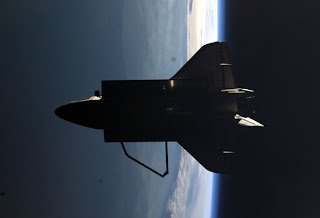
There's just one more day in orbit left for the four astronauts on space shuttle Atlantis, the last men and women ever to fly on a NASA shuttle.

Commander Chris Ferguson and his crew have worked steadily and successfully through the bulk of their 13-day mission. The astronauts departed the International Space Station yesterday (July 19), after delivering a huge load of backup hardware and supplies. [Photos: Shuttle Bids Farewell to Space Station]

Now Atlantis is packed to the brim with trash and other items to be brought back to Earth, and the astronauts are making their final preparations for a planned predawn landing on Thursday (July 21).

"The crew is doing great," LeRoy Cain, chair of Atlantis' mission management team, said in a briefing on Tuesday (July 19). "They’ve performed an outstanding mission. We're focused now on getting Atlantis and the crew back."

Read More

Kepler's Insight to Physical Nature of Planetary Systems

nasa kepler
It’s been 808 days since the launch of one of NASA’s most prolific space observatories: the Kepler exoplanet-hunting space telescope. Kepler team members met in Boston this week at the meeting of the American Astronomical Society (AAS) to give a status report on their progress toward answering one of the most timeless questions in astronomy: how abundant are Earth-sized planets in the Galaxy?

They are methodically closing in on the answer, but certainly not there yet.

For the past two years, the spacecraft has kept a steady gaze on 165,000 stars in the summer constellation Cygnus. To date, Kepler has tallied 1235 candidate exoplanets with orbits inclined such that they can be seen passing in front of their stars. This trawl has required a staggering 5.5 billion separate brightness measurements.

Read More

Space Station Returns 3 Crew Members to Earth

Nasa
The International Space Station will release two astronauts and a Russian cosmonaut, returning them to earth tonight after more than five months living and working in orbit.

Russian cosmonaut Dmitry Kondratyev, Expedition 27 commander, and astronauts Catherine (Cady) Coleman of NASA and Paolo Nespoli of Italy will be landing their Russian-built Soyuz space capsule somewhere in Central Asia, probably on the steppes of Kazakhstan.

Kondratyev, Coleman and Nespoli will depart from the space station while the space shuttle Endeavour and its six-astronaut crew are docked at the orbiting laboratory. Endeavour is being retired following this, its last mission. The shuttle's team is half way through a 16-day mission to aid in the space station's day-to-day following the end of NASA's space shuttle program.

"I think we've done a lot of great science, and certainly I think the space station is in a really good state for the future," Coleman said, according to Space.com.

Read More

NASA clears shuttle Endeavour for April 29 launch

Endeavour
The shuttle Endeavour was cleared for a launch attempt on April 29 to deliver a new class of physics instrument to the International Space Station on NASA's next-to-last shuttle flight, officials said Tuesday.

Liftoff of the 134th shuttle mission is scheduled for 3:47 p.m. EDT from the Kennedy Space Center in Florida.

The all-veteran crew is led by Mark Kelly, husband of Arizona Democratic Representative Gabrielle Giffords, who is recovering from a January 8 shooting that killed six people and injured 12 others.

Pending approval from her doctors, Giffords, who has not been seen publicly since the attack outside a Tucson, Arizona, grocery store, plans to attend the launch, Kelly has said.

The primary purpose of the flight is to deliver the $2 billion Alpha Magnetic Spectrometer, or AMS, particle detector, an instrument designed to detect dark matter, antimatter and other exotic phenomena.

"It has the potential of returning really Earth-shattering science," said NASA's Bill Gerstenmaier.

A team of 600 scientists from 16 nations, including China and Taiwan, are partners in the project.

After installing AMS the Endeavour astronauts will turn their attention to four spacewalks and other tasks to help get the space station ready for operations without shuttle support. The station is a $100 billion project of the United States, Russia, Europe, Japan and Canada that has been under construction since 1998, 220 miles above Earth.

Read More

Final Landings for NASA’s Space Shuttles — and some planning thoughts

Space shuttle landing
The news of the decision was made last week. Fierce competition for the three remaining Space Transport System (STS) vehicles — “Space Shuttles” in non NASA speak — which have been in orbit, as well as the engineless Enterprise which flew in Earth’s atmosphere but not designed for orbital missions — was had though the cost to each museum would be high. Estimated costs are around $28 million USD to render each shuttle safe for public display and transport with the added hefty requirement to display the each shuttle indoors.

Here are the locations with some added thoughts:

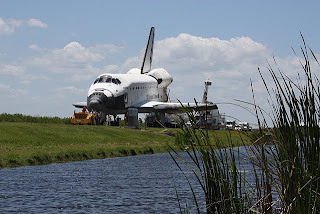
STS Atlantis will go to the Kennedy Space Center (KSC) in Cape Canaveral, Florida. I am not sure if the existing buildings there will house her, or not. Getting Atlantis to KSC will be easy as she has been routinely flown there in order to accomplish her missions but getting her to the display site will need some attention.

STS Discovery is destined for the National Air & Space Museum Steven F Udvar-Hazy Center in Chantilly, Virginia near Washington DC. This museum is the current home for STS Enterprise which will be transported to the Intrepid Sea, Air & Space Museum in New York City, New York. The Udvar-Hazy Center is located in the southeastern corner of Dulles International Airport and the design of the museum reflects that of an extremely large aircraft hangar. Extracting the Enterprise and inserting the Discovery should be a straight forward affair though one that would be interesting to watch. Dulles may experience a unique event, NASA’s shuttle carrying Boeing B-747 landing with one shuttle and taking off with another.

STS Endevour has been slated to retire to the California Science Center in Los Angeles, California. This museum has a Lockheed A-12 “Blackbird” nicknamed individually”Titanium Goose”* on outside display along with a Douglas DC-8 also on outside display. The museum is not on an airfield — getting the Endevour to LAX will be easy enough to accomplish but taking her over 10 miles (16km) of urban roadways will be challenging and a new building will be required.

Read More

NASA’s Space Shuttle Train Is Basically A Giant, Moving Bomb


NASA’s Space Shuttle Train Is Basically A Giant, Moving Bomb but it’s actually very safe! And yes, NASA has a railroad. It’s been around since 1963, actually—so apologies to space nuts who’ve known about it for a while—but only recently has the agency uploaded an expose to YouTube.


Seriously, though, this train takes huge, volatile rocket booster segments and fuel from Utah to the Kennedy Space centre on specialised railroad cars, and has been doing so since 1963. It’s been upgraded since then, of course, but the goal remains the same: Take those boosters and fuel from where they’re processed, refitted, fixed and manufactured, and get them to the launch pad in Florida.

Sadly, the last rocket load was moved in May 2010, in preparation for the final space shuttle flights (beginning with Discovery earlier this month). That said, the railroad will continue to serve NASA in other ways, officials say in the video, which we hope to mean future manned and un-manned space missions.

Read More

AIM-Aeronomy of Ice in the Mesosphere

The Aeronomy of Ice in the Mesosphere (AIM) satellite mission is exploring Polar Mesospheric Clouds (PMCs), also called noctilucent clouds, to find out why they form and why they are changing.

The AIM mission has been extended by NASA through the end of FY12. During this time the instruments will monitor noctilucent clouds to better understand their variability and possible connection to climate change. Individual instrument data collection status, as well as spacecraft and instrument health, will be monitored throughout the life of the mission and reported periodically

The Aeronomy of Ice in the Mesosphere (AIM) is a satellite to conduct a 26-month study of noctilucent clouds (NLCs). It is ninetieth Explorer program mission and is part of the NASA-funded Small Explorer program (SMEX). On April 25, 2007 AIM was boosted into a 600 km (370 mi) high polar orbit by a Pegasus-XL rocket, which was air-launched from the Lockheed L-1011 Stargazer aircraft operated by Orbital Sciences.

The noctilucent clouds AIM is to study, also known as polar mesospheric clouds, occur in the Earth's atmosphere at altitudes of roughly 80 kilometers (50 mi) above the surface, far higher than other clouds. The AIM mission will help determine what factors — temperature, water vapor, and dust particles — lead to the formation of these clouds. The clouds seem to be a relatively recent phenomenon: they were first seen in 1885, and lately seem to be occurring more frequently.

Discovery External Tank Repairs Begin Monday as Engineers Analyze Data

Technicians working on space shuttle Discovery's external fuel tank in the Vehicle Assembly Building at NASA's Kennedy Space Center in Florida are off for the New Year holiday weekend. On Monday, they'll begin repairs on three support beams, called stringers, that recently were detected to have small cracks on their tops.

Engineers at various NASA centers continue to analyze data from testing and X-ray type image scans collected during the past week of all 108 stringers on the outside of the external tank's ‪intertank section. The image scans showed four small cracks on three stringers on the opposite side of the tank from Discovery. Managers decided Thursday to have those cracks repaired in a similar fashion to repairs made on cracks on two stringers found after Discovery's Nov. 5 launch attempt.

The repair work is estimated to take 2–3 days. Any further work will be evaluated thoroughly during the week after additional data and analysis are reviewed.

Managers also continue to evaluate an option to perform known and practiced modifications on some stringers. Before breaking for the holiday, technicians reconfigured scaffolding to provide access for the modification work, should it be required. A decision may be made on that work as early as Monday.


View this site boat building, boat builders, wood preservative, construction marine, marine contractors

Space Shuttle Mission: STS-133

Technicians will work this weekend to prepare space shuttle Discovery's external tank for a tanking test planned for no earlier than Wednesday. Because the test hopes to glean a great deal of information, technicians will place 89 instruments including strain gauges to the tank to precisely record movement and temperatures from the tank's ribbed intertank area as it chills and warms again during the fuel loading and emptying process. The tank holds super-cold liquid oxygen at minus-297 degrees and liquid hydrogen at minus-423 degrees. The cryogenic propellants cause the tank to shrink by about half an inch.

Discovery and Payload at Launch pad


Space shuttle Discovery's payload for its STS-133 mission to the International Space Station is at Launch Pad 39A where workers will load it into the shuttle's payload bay. Discovery will carry the Permanent Multipurpose Module to the station during the upcoming mission. The module, which will remain attached to the station after Discovery leaves, is loaded with spare equipment, experiments, supplies and Robonaut 2, the first humanoid robot to go into space. Launch is targeted for Nov. 1 at 4:40 p.m. EDT.

Soyuz Moved to Pad for Thursday Launch to Station


The Soyuz spacecraft that will carry three new Expedition 25 flight engineers to the International Space Station was rolled out to the launch pad at the Baikonur Cosmodrome in Kazakhstan on Tuesday. NASA astronaut Scott Kelly and Russian cosmonauts Alexander Kaleri and Oleg Skripochka will launch aboard the new Soyuz TMA-01M Thursday at 7:10 p.m. EDT (Friday, Kazakhstan time) and begin a five-month tour of duty aboard the station after docking to the Poisk module Saturday evening.

Meanwhile, the three Expedition 25 crew members already living and working aboard the station conducted a depressurization drill, collected data for science research and prepared for the installation of a device to produce water.

Commander Doug Wheelock began his workday early by participating in the Pro K experiment, which studies dietary countermeasures to lessen the bone loss experienced by astronauts during long-duration spaceflight. With assistance from Flight Engineer Shannon Walker, Wheelock collected a blood sample and stored it in the Minus Eighty-Degree Laboratory Freezer for ISS for study later by scientists back on Earth.

space shuttle Discovery's final spaceflight


During space shuttle Discovery's final spaceflight, the STS-133 crew members will take important spare parts to the International Space Station along with the Express Logistics Carrier-4. Discovery has been moved to Launch Pad 39A at NASA's Kennedy Space Center in Florida. STS-133 is slated to launch Nov. 1.

NASA Kennedy Space Center's Launch Pad 39A, work continues to prepare space shuttle Discovery for its STS-133 mission, targeted to launch Nov. 1 at 4:40 p.m. EDT. Technicians have completed prelaunch propellant servicing operations, and the mission's payload -- the Permanent Multipurpose Module, Express Logistics Carrier 4 and an array of spare hardware -- is set to be installed Thursday inside Discovery's payload bay.

The six-person STS-133 astronaut crew will practice procedures for the missions first spacewalk today in NASA Johnson Space Center's Neutral Buoyancy Laboratory.

Join Discovery to External Tank

During space shuttle Discovery's final spaceflight, the STS-133 crew members will take important spare parts to the International Space Station along with the Express Logistics Carrier-4. Discovery is being readied for flight inside Kennedy's Orbiter Processing Facility-3 while its solid rocket boosters are stacked inside the nearby Vehicle Assembly Building. STS-133 is slated to launch Nov. 1.

Space shuttle Discovery, joined to its external fuel tank and twin solid rocket boosters, is standing on its mobile launcher platform inside the Vehicle Assembly Building today as technicians get ready to move it to the launch pad this evening. A crawler-transporter has been positioned just outside the VAB's mammoth doors and will move inside later today so the stack can be placed on its sizeable back for the move. The rollout at NASA's Kennedy Space Center in Florida will take about six hours. Discovery's crew of six astronauts are to perform an integrated entry simulation today at their training base at NASA's Johnson Space Center in Houston.

Observe the Moon


The moon is the Earth's nearest celestial neighbor and a geologic wonderland. There are mountains that are many miles high, lava flows several hundred miles long and enormous lava tubes and craters of every size. It is the brightest object in the night sky and has profoundly influenced the course of human civilization.

For early humans, the moon provided lighting for hunting and defined when crops should be planted and harvested. Markings of lunar phases appear in cave paintings in France and defined the arrangement of Stonehenge.

The 2010 International "Observe the Moon Night" is happening on Saturday, Sept. 18. On Thursday, Sept. 16, at 3:00 p.m. EDT, Dr. Rob Suggs of NASA's Marshall Space Flight Center in Huntsville, Ala., will answer your questions about the moon and National Observe the Moon Night. Joining the chat is easy. Simply return to this page a few minutes before the chat time on Thursday. The chat module will appear at the bottom of this page. After you log in, wait for the chat module to be activated at 3:00, then ask your questions!

A Snapshot of Sea Ice


How does the Aqua satellite "see" sea ice? Microwaves. Everything on Earth’s surface -- including people -- emits microwave radiation, the properties of which vary with the emitter, thereby allowing the AMSR-E microwave sensor on Aqua to map the planet.

Ice emits more microwave radiation than water, making regions of the ocean with floating ice appear much brighter than the open ocean to the AMSR-E sensor. This difference allows the satellite to capture a sea ice record year-round, through cloud cover and the months of polar night. Continuous records are important because sea ice is dynamic. Besides melting and freezing, the ice moves with wind and currents which can cause it to split or pile up.

"The data from AMSR-E and other NASA satellites are critical for understanding the coupling between sea ice and the ocean and atmosphere," said Tom Wagner, Cryosphere program manager at NASA Headquarters in Washington. "It’s important for us to understand these connections to improve our predictive models of how the planet will change."

Cassini Captures a Divine Dione

Cruising past Saturn's moon Dione this past weekend, NASA's Cassini spacecraft got its best look yet at the north polar region of this small, icy moon and returned stark raw images of the fractured, cratered surface.

The new images also show new views of the long, bright canyon ice walls, which scientists working with NASA's Voyager spacecraft called "wispy terrain" in the early 1980s. These ice walls thread along the surface of the moon's trailing hemisphere and cut across craters.

The Cassini-Huygens mission is a cooperative project of NASA, the European Space Agency and the Italian Space Agency. JPL, a division of the California Institute of Technology in Pasadena, manages the mission for NASA's Science Mission Directorate, Washington, D.C. The Cassini orbiter and its two onboard cameras were designed, developed and assembled at JPL. The imaging operations center is based at the Space Science Institute in Boulder, Colo.

Magnetospheric Mission Passes Major Milestone


On the sun, magnetic reconnection causes solar flares more powerful than several atomic bombs combined. In Earth's atmosphere, magnetic reconnection dispenses magnetic storms and auroras, and in laboratories on Earth it can cause big problems in fusion reactors.

Although the study of magnetic reconnection dates back to the 1950s and despite numerous scientific papers addressing this perplexing issue, scientists still cannot agree on one accepted model.

In 2014, NASA is scheduled to launch a satellite that will greatly increase our understanding of this phenomenon when it launches the Magnetospheric Multiscale (MMS) mission, a suite of four identical spacecraft that will study magnetic reconnection in the best possible laboratory – the Earth’s magnetosphere. The spacecraft will obtain measurements necessary to test prevailing theories as to how reconnection is enabled and how it progresses.

Kepler Mission Discovers Two Planets Transiting the Same Star


Kepler spacecraft has discovered the first confirmed planetary system with more than one planet crossing in front of, or transiting, the same star.

The transit signatures of two distinct planets were seen in the data for the sun-like star designated Kepler-9. The planets were named Kepler-9b and 9c. The discovery incorporates seven months of observations of more than 156,000 stars as part of an ongoing search for Earth-sized planets outside our solar system. The findings will be published in Thursday's issue of the journal Science.

Kepler's ultra-precise camera measures tiny decreases in the stars' brightness that occur when a planet transits them. The size of the planet can be derived from these temporary dips.

The distance of the planet from the star can be calculated by measuring the time between successive dips as the planet orbits the star. Small variations in the regularity of these dips can be used to determine

Artemis Spacecraft First to Enter New Type of Orbit


The full Moon yesterday evening helped light the way for NASA's ARTEMIS-P1 to become the first spacecraft successfully placed into an Earth-Moon libration orbit.

At 12:33 a.m. on August 25 NASA engineers, in association with the University of Berkeley Space Sciences Laboratory operations facility, performed a propulsion maneuver to capture ARTEMIS-P1 into the Earth-Moon L2 Lagrangian point, located on the far side of the Moon from Earth about 38,100 miles (61,300 km) above the lunar surface. The orbit is unique because it relies on a precise balancing of the Sun, Earth, and Moon’s gravity.

In October, its sister spacecraft – ARTEMIS-P2 – will be captured into the Earth-Moon L1 Lagrangian point located between the Earth and Moon.

Station Crew Busy With Science and Maintenance

The Expedition 24 crew members were busy with a variety of science experiments and maintenance activities Wednesday as they orbited the Earth aboard the International Space Station.

In the Japanese Kibo module, Flight Engineer Doug Wheelock set up equipment in the Fluid Physics Experiment Facility for a study of the Marangoni effect, which is the flow of liquids caused by surface tension.

Flight Engineer Tracy Caldwell Dyson changed out hardware and removed samples from the Multi-user Droplet Combustion Apparatus, which is part of the Combustion Integrated Rack (CIR) in the U.S. Destiny laboratory. The CIR is an experiment facility that helps researchers study how different materials combust in the microgravity environment aboard the station and can be operated by crew members or remotely by researchers on Earth.

Flight Engineer Shannon Walker analyzed water samples from the station’s Water Recovery System.