NASA plans multi-rocket science launch

NASA says a science mission this week will briefly create a milky white cloud that may be visible along a large portion of the U.S. East Coast.

Five sounding rockets will be launched in quick succession Tuesday from the Wallops Flight Facility in Wallops Island, Va., and each will release a chemical tracer at different altitudes to create clouds allowing scientists and the public to "see" the winds in space, the space agency said Monday.

multi-rocket science launch

The Anomalous Transport Rocket Experiment mission -- to gather information needed to improve understanding of the high-altitude jet stream located 60 to 65 miles above the surface of Earth -- is set to launch between 2 a.m. and 5 a.m. EST Tuesday.

The launch will need clear skies not only at Wallops Island but also in North Carolina and New Jersey, where camera sites will record the results of the experiment, NASA said.

The latest weather forecasts appear to be favorable, with clear weather forecast along the Atlantic Seaboard, but possible gusty winds could ground the rockets for another night.

Read more: http://www.upi.com/Science_News/2012/03/26/

NASA delays rocket launch to study jet stream

NASA has late its organized launch of five rockets targeted at studying more about the jet stream's present at the side of space.

Nasa rocket
NASA at first said it would deliver up five rockets in five moments from seaside Va beginning Exclusive. But it therefore declared Exclusive the discharge was clean due to a payload problem. The next effort will be no previously than Exclusive evening.

The rockets are to launch a chemical type pathway to monitor gusts of wind circling World at up to 300 mph, about 65 kilometers above the exterior.

Officials had said long, milky bright atmosphere could be noticeable for about 20 moments from Myrtle Seaside, S.C., to the southeast part of New Hampshire, and as far western as Morgantown, W.Va. - climate allowing. That area contains California, Baltimore, Chicago, New You are able to and Birkenstock boston.

Halloween Costumes

Saudi academic to be first Arab member of NASA research team

The National Aeronautics and Space Administration (NASA), an American space agency, has accorded its relationship to a Saudi academic Dr. Majdah Aburass, making her the first Arab woman to join its research squad of scientists. Dr. Aburas holds a doctorate degree from the University of Surrey in environmental studies and biotechnology, concentrate in oil pollutions.

Arab Member of NASA

Aburas, who is currently a faculty member at King Abdulaziz University in Jeddah and researcher in environmental sciences, ecology, sustainable development ─ where she lectures on different disciplines such as microbiological pollution, physiology of microorganisms, industrial microbiology and ecological pollution ─ will join the team at NASA to support and create a series of projects for the development of the Gulf region. She was also appointed as a member of the science division at NASA’s regional office.

Muhammad Ibrahim al-Rashid, president of NASA affiliate the Gulf American Foundation for Space, Technology and Environment, told Arab News that Aburas was appointed as a member of the regional research team over her national initiatives to protect the environment. “It was the result of her continuous work for the environment to solve its problems,” he said.

Aburas told Al Arabiya that she is proud of this appointment and credits her achievements to King Abdullah. She says “King Abdullah’s reign is considered as the golden era for women in Saudi; he is a true leader and a visionary. His latest verdict to allow women to participate in the Shoura Council and the municipal polls was historical and ensures equitable and effective representation of women in decision-making structures,” she added.

As for her new role, she said her appointment came as a result of a collaboration with NASA on a project that she hopes will be implemented in the near future. She said she will be based at NASA headquarters for a month in The United States. where she will have the chance to work closely with other NASA researchers.

Thanks: english.alarabiya.ne

Halloween Costumes

NASA's SDO spacecraft captures solar eclipse in space

solar eclipse
A NASA spacecraft has detained footage of Tuesday's partial solar eclipse. NASA's Solar Dynamics Observatory (SDO) captured images of the new Moon crossing part of the Sun's face in a incomplete eclipse that was visible only from space. For more information about solar eclipses, check out an online high school to find science classes that can teach you how solar eclipses happen and its significance to sun-earth interactions.

Space.com reports that SDO snapped a video and photos of the solar eclipse which made the Sun look like a "huge celestial Pac-Man," from a position 22,000 miles (36,000 kilometers) above the Earth. According to SDO , "The video shows today's Lunar Eclipse in a variety of wavelengths the AIA instrument observes. Each wavelength shows us a different temperature and layer of the Sun, allowing us to study the Sun and its activities."

SDO officials tweeted a message on the mission's mascot Twitter account, @Camilla_SDO: "It's a PacMan sun! The moon is transiting between @NASA_SDO and the sun today!"
The incident, according to SDO officials, caused a dip in EVE (extreme ultraviolet) output and gave scientists opportunity to calibrate the energy emitted by the active sunspot region AR1422 that has been emitting strong ultraviolet radiation into space. The AR1422 region was blocked in the Moon's passage across the face of the Sun.

An eclipse occurs when the moon passes between the Earth and the Sun. A total eclipse occurs when there is an exact alignment between the Moon and the Sun as viewed from the Earth. When the alignment is not exact, we have a partial eclipse. Space.com reports a total eclipse will take place on November 13, but will be visible only from parts of northern Australia and the South Pacific. A partial eclipse will occur on May 20 and will be visible in much of Asia, the Pacific and western North America, says NASA.

Thanks: digitaljournal.com

Halloween Costumes

How NASA Makes Those Incredible High-Res Images of Earth

nasa
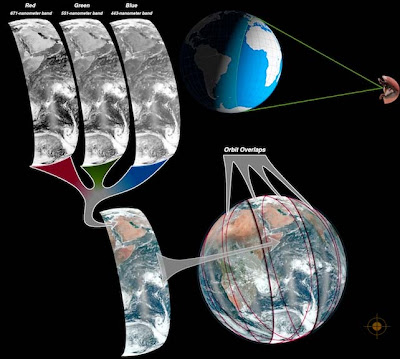
How were these highly thorough imagery created? The satellite flies 512 miles on top of the Earth, but the images appear as if they were taken from a much higher perspective: an altitude of 1,242 for the first image and 7,918 miles for the second. This little trick was accomplished by stitching together data from several orbits, creating an image that appears to be “pulled back.”

NASA launched the 4,600-pound Suomi in October to remotely sense variations in the Earth’s oceans, continents, and atmosphere and get a better understanding of climate change. It passes directly from pole to pole 14 times a day, imaging 1,865-mile swaths of our planet with each trip.

On board Suomi, the Visible Infrared Imaging Radiometer Suite (VIIRS) instrument takes pictures in red, green, and blue wavelengths. For the whole-Earth images, those wavelengths were combined to create a natural color photograph. It is not an exact representation of what an observer sitting in space would see, because particles in the atmosphere scatter short wavelengths of light, and our planet would actually appear more blue-tinged. The photos more accurately portray how the oceans and continents appear from the ground.

Oceanographer Norman Kuring, who compiled the two pictures, said the original image, showing North and Central America, was made as a favor to project scientist James Gleason who was looking for an ocean color image to show in a presentation. Word got out of the striking picture and NASA officials released it on Jan. 25, resulting in 3 million people viewing it in one week.

NASA Says No to Probe Crash Theory Test - Roscosmos

Roscosmos
NASA has reject to contribute in an experiment designed to show if U.S. radars could have had an impact on Russia’s troubled Phobos-Grunt Mars probe, the deputy head of the country’s space agency, Roscosmos, Anatoly Shylov said on Thursday.

Roscosmos filed an official request to the U.S. side to participate in the investigation, but they refused,” Shylov said.

The official also said that the government commission inquiry into the cause of the probe’s crash had issued a final report with the results of the investigation. It is expected to be published next week.

Among the possible causes of the Phobos-Grunt probe’s crash, investigators said interference from the U.S. radar installed on the Marshall Islands in the Pacific Ocean could have had an impact. Scientists however dismissed the idea, saying that the U.S. radar theory is cover up to hide some people’s mistakes.

Thanks: http://en.ria.ru/russia

2011 Was Ninth Warmest Year On Record

nasa
NASA make public a temperature analysis for 2011, which shows that previous year was among the ten (10) warmest years since 1880, when the Goddard Institute for Space Studies (GISS) in New York began keeping record of global temperatures.

Nine(9)of the warmest years were recorded in the 21st century; 1998 is the only 20th century entry in the ranking. NASA said that the average temperature around the globe in 2011 was 0.92 degrees F (0.51 C) warmer than the mid-20th century baseline. The difference between 2011 and 2010, the warmest year on GISS record, was 0.22 degrees F (0.12 C).

"We know the planet is absorbing more energy than it is emitting," said GISS Director James Hansen in a prepared statement. "So we are continuing to see a trend toward higher temperatures. Even with the cooling effects of a strong La Niña influence and low solar activity for the past several years, 2011 was one of the 10 warmest years on record."

The increasing level of greenhouse gases is blamed for the an ongoing temperature increases, which NASA says may vary from year to year, but will continue to climb in the future on average. To learn more information about greenhouse gases, check out online colleges to find biology classes that can teach you more about the types of greenhouse gases. GISS noted that the carbon dioxide concentration in the atmosphere was about 285 parts per million in 1880, about 315 parts per million in 1960 and is above 390 parts per million today. Hansen said he expects record-breaking global average temperature in the next two to three years because of increasing solar activity and the "next El Niño will increase tropical Pacific temperatures".

Thanks: http://www.tomsguide.com/us

NASA picks Mont. students' names for moon probes: Ebb, Flow

moon probes
Fourth-graders in Montana have won the NASA grail by naming the previously nameless twin spacecraft orbiting the moon "Ebb" and "Flow."

NASA's rocket scientists were too busy creating the Gravity Recovery and Interior Laboratory (yes, GRAIL) probes to give them proper names and had simply called them "A" and "B." So, back in October, a month after the unmanned craft were launched, the space agency launched the naming contest.

More than 11,000 students in nearly 900 classrooms in 45 states, the District of Columbia and Puerto Rico participated. The winning entry came from the 28 students in Nina DiMauro's class at the Emily Dickinson Elementary School in Bozeman, Mont., NASA said.

"They noted the fact that GRAIL is going to be studying gravity on the moon, and that the effect of gravity on the Earth is seen every day in terms of tides," principal investigator Maria Zuber of the Massachusetts Institute of Technology told AFP. "So they chose Ebb and Flow because it was the daily example of how the moon's gravity is working on the Earth."

Read More: http://content.usatoday.com

NASA Rover Takes 'Winter Vacation' to Power Solar Panel

mars rover
NASA has sent its Mars Rover, Opportunity, on its first winter working vacation since the solar-powered vehicle began exploring the red planet’s surface several years ago.

Similar to humans who travel to sunny locations during the winter, the robotic rover will spend the next several months literally soaking up sunlight. The U.S. space agency, NASA, says it positioned Opportunity with its solar panel angled toward the Sun to make sure the rover will have enough power to last for the duration of the long Martian winter.

Mission scientists say it was not necessary for Opportunity to be kept in a Sun-facing position the previous four Martian winters because its landing site just south of the planet's equator gets relatively strong sunlight year-round. They decided to use the maneuver this year because the rover’s solar panels were caked with an unusually thick coating of dust.

NASA says Opportunity is sitting on the slope of a rocky outcrop that lies along the rim of Mars’ 22-kilometer-wide Endeavour Crater. Scientists say they have identified a variety of interesting features for the rover to investigate with its robotic arm while its solar panels store up energy from the Sun. NASA says it does not plan to move the golf cart-sized vehicle more than a meter or two until June or July when Opportunity will resume its current mission exploring Endeavour Crater.

Read More: www..voanews.com

NASA’s RXTE reveals secrets of smallest known black hole

Black Hole
The black hole, which is smaller than any previously discovered, is a mere 16,000 to 65,000 light-years away. Officials said Friday that they have detected the “heartbeat” of the the black hole, noting that if it exists, it would weigh less than three times the mass of the sun, placing it near the theoretical minimum mass required for black holes. NASA officials say the size of the black hole makes it a contender for the title of smallest black hole ever discovered. Science classes at accredited online colleges should also be able to teach you how the first blackholes were born.

The NASA team used the Rossi X-ray Timing Explorer (RXTE) satellite to identify a candidate for the smallest-known black hole, saying the latest calculations may place the black hole’s mass below the minimum necessary to sustain a cosmic giant.

“We think that most of these patterns represent cycles of accumulation and ejection in an unstable disk, and we now see seven of them in IGR J17091,” said Tomaso Belloni at Brera Observatory in Merate, Italy. “Identifying these signatures in a second black hole system is very exciting.”

The space agency said the record-sized black hole is named IGR J17091-3624 after the astronomical coordinates of its sky position.

Read more:thestatecolumn.com

NASA announces 1st private spacecraft flight to ISS

Nasa
US space agency National Aeronautics and Space Administration (NASA) has announced the launch date for the first test flight of a commercial spacecraft to the International Space Station (ISS). The mission, which will test a vehicle intended to carry cargo and eventually crew to orbit
represents an important step for the burgeoning private space industry, experts say.

SpaceX is going to send its unmanned space capsule Dragon to rendezvous with the International Space Station (ISS) on February 7 next year.

This will be the first time that NASA would use a commercial flight to ferry supplies up to the ISS.

Elon Musk’s company, SpaceX, has been approved by NASA to make its first commercial supply run to the ISS. SpaceX has been working on its Dragon "reusable flying aircraft" to get it ready for its first big supply run.

"SpaceX is excited to be the first commercial company in history to berth with the International Space Station," the company's president Gwynne Shotwell said in a statement.

"This mission will mark a historic milestone in the future of spaceflight. We appreciate NASA's continued support and their partnership in this process."

This flight, which is the second for the company under NASA's Commercial Orbital Transportation Services (COTS) program, will send the Dragon capsule into orbit to rendezvous with the orbiting complex in a single flight, NASA officials said.

Source : www.hindustantimes.com

NASA’s Kepler telescope continues to reveal strange and new planets

nasa
NASA will reportedly announce the discovery of a number of newly discovered planets on Monday, the latest batch of mysterious worlds to be added to the space agency’s growing list of celestial bodies.

NASA will reveal the latest batch of discoveries made by its planet-hunting Kepler space telescope on Monday, according to a statement released by the space agency. NASA says it will hold a press conference at its Ames Research Center in Moffett Field, California. The press conference is the first of the inaugural Kepler Science Conference, which will focus on findings made by the Kepler telescope. The conference will run from December 5 to December 9 and will feature more than 110 scientific presentations, officials said.

“The briefing will provide an update on the statistical findings since Kepler’s Feb. 1, 2011, science data release and introduce a new confirmed planetary discovery,” NASA officials said in a statement released Friday The space agency says the this year’s annual announcement will continue a long tradition that it anticipated to accelerate in the coming years as the Kepler Telescope continues to search for earth-like planets. NASA officials say they expect a number of significant discoveries by Kepler this year.

“Sooner or later, Kepler will find a lukewarm planet with a size making it probably Earthlike,” said Geoffrey Marcy of the University of California, Berkeley. “We’re no more than a year away” from such a discovery, he said The announcement comes as NASA announced Friday the discovery of an earth-sized planet that is reportedly hot enough to melt iron.

Source:www.thestatecolumn.com

NASA Will Continue U.S. Space Leadership

nasa
I respectfully disagree with Homer Hickam's "The Commercial Space Age Has Begun" ( America has been the world leader in space exploration for 50 years, and under the ambitious plan laid out by President Obama and Congress, we will continue to lead for at least the next half-century The president has challenged NASA to accomplish big things—to rendezvous with an asteroid by 2025 and send humans to Mars in the 2030s. These are specific goals toward which NASA is planning and making investments.

Our vision for the future is clear: hand off low-Earth orbit transportation to the private sector; develop the technology and vehicles needed to explore deep space, eventually landing a human mission on Mars; and help develop quieter and cleaner airplanes, all while inspiring our young people to out-innovate and out-compete the rest of the world.

NASA recently launched the most ambitious mission ever to Mars, the Curiosity rover, to help answer questions about conditions for life beyond Earth. America's love of space exploration and its crucial role in our nation's life and priorities is stronger than ever

Source:http://online.wsj.com

Nasa doing research inmany fields

solar panel
Chief technologist, System Engineering Directorate, Nasa Langley Research Center, USA, U N Singh on Sunday said that Nasa was America's leading scientific centre for research and exploration in the fields of space science and technology, environmental studies and worldwide geographical changes.

Delivering the keynote lecture on 'Nasa's Future Earth Science Missions for Global Observations' at the Indian Institute of Business Management (IIBM), Singh said that at Nasa, besides space and satellite technology, research is also going on geo-informatics, laser and optical techniques. Research on Earth-related mission was also going on. It would also lead to understanding the disintegration of ozone layer in the environment, he pointed out. He said that through remote sensing, one can carry out research on atmospheric changes and their effects on the earth.

Read More : http://timesofindia.indiatimes.com/city/patna/Nasa-doing-research-inmany-fields/articleshow/10898697.cms

NASA's Antarctic 2011 IceBridge Campaign Concludes

nasa_icebridge
NASA's DC-8 airborne science laboratory has completed its 2011 Operation IceBridge science flights over Antarctica, and arrived home at its base in Palmdale, Calif., Nov. 22. The IceBridge flight and science team flew a record 24 science flights during the six-week campaign, recording data from a suite of sophisticated instruments on the thickness and depth of Antarctic ice sheets and glacial movement The aircraft departed its deployment base at Punta Arenas, Chile, Tuesday morning Nov. 22 and after a refueling stop in Santiago, Chile, set course for Los Angeles International Airport for customs clearance. The flying lab continued on to the Dryden Aircraft Operations Facility in Palmdale, arriving about 8:30 p.m. that evening after almost 15 hours in the air.

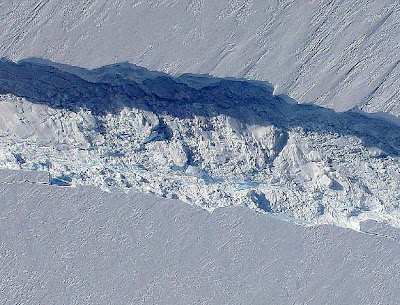
A highlight of the IceBridge mission was the discovery during a low-level overflight Oct. 14 of a large crack that had recently begun across the Pine Island Glacier ice shelf, a precursor to the separation of an estimated 310-square-mile iceberg into the ocean in the near future. The growth of the estimated 18-mile-long rift was documented on several subsequent flights The final science flights on Nov. 17 and 19 focused on the middle of the Antarctic Peninsula and the George VI Sound on the peninsula's western side.

Mission manager Chris Miller's report on the former noted that clear weather over the eastern side of the peninsula provided "a rare opportunity to collect data over glaciers that are more regularly shrouded in cloud." The mostly clear weather allowed the science team to collect data at low altitudes of only 1,500 feet above ground for almost seven hours out of the more than 11 hours the team was aloft.


NASA ISS On-Orbit Status 20 November 2011

iss
All ISS systems continue to function nominally, except those noted previously or below. Sunday. Ahead: Week 1 of Increment 30 (thirty) Today 12(twelve) years ago (1998), the 20-ton FGB "Zarya" (Sunrise), the first module of the ISS, was launched at Baikonur/Kazakhstan on a three-stage Proton. The US-financed "Funktsionalnyi-Grusovoi Blok" was built by KhSC (Khrunichev State Research & Production Space Center) from their original Almaz program under subcontract to Boeing.<<<

Crew Wake/Sleep cycle shift: To accommodate Soyuz 27S undock tomorrow evening at 6:00pm EST, crew wake/sleep cycle changes go into effect, featuring a late turn-in today and tomorrow, plus a free day Tuesday:

WAKE (EST) SLEEP (EST)

* Today (11/20) 1:00am 6:00pm
* Tomorrow (Monday, 11/21) 6:30am 1:00am (11/22)
* Tuesday (11/22) Free Day ~4:30pm
* Wednesday (11/23) 1:00am 4:30pm (regular)

After wakeup, FE-4 Volkov performed the routine inspection of the SM (Service Module) PSS Caution & Warning panel as part of regular Daily Morning Inspection.First thing in Postsleep, prior to eating, drinking & brushing teeth, CDR Fossum, FE-3 Burbank & FE-5 Furukawa today conducted the dry saliva sample collections on the INTEGRATED IMMUNE protocol. Later in the day, Mike, Dan & Satoshi also completed the IMMUNE blood sample draws, with Dan assisting Satoshi as Operator and vice versa, plus Satoshi assisting Mike. Following the blood draws, the full blood tubes were temp stowed in the blood collection kit until tomorrow when they will be packed together with the saliva samples on the Soyuz for return to ground. [INTEGRATED IMMUNE (Validating Procedures for Monitoring Crew member Immune Function) samples & analyzes participant's blood, urine, and saliva before, during and after flight for changes related to functions like bone metabolism, oxidative damage and immune function to develop and validate an immune monitoring strategy consistent with operational flight requirements and constraints.

Budget, Technical Woes Hamper Space Ventures

nasa rocket
Launch delays and shrinking federal budgets threaten NASA's plan to rely on private rockets to ferry astronauts and equipment to the international space station, government and industry officials said the first commercial cargo run to the station has now likely slipped from late this year or in January to as late as April—largely because engineers from one company are laboring over spacecraft-guidance software.

Meanwhile, the House as early as Thursday is expected to cut National Aeronautics and Space Administration funding for the development of privately built and operated systems to blast astronauts into orbit the budget woes and technical delays come as the U.S. makes the transition to using commercial operators to transport crews and cargo after retiring its fleet of space shuttles. The first step is for a pair of U.S. companies to come up with private launchers and spacecraft to haul supplies—but not yet people—to the station.

Closely-held Space Exploration Technologies Corp. aims to do the job with its Dragon capsule atop its 19-story-tall rocket, the Falcon 9. After the first launch of that combination in December 2010, the company predicted cargo deliveries would begin within a few months. The Hawthorne, Calif., company, also known as SpaceX, now has internal estimates it could start deliveries at the earliest in February or March, 2012, the government and industry officials said.

Russian, U.S. crew blast off for space station

Russian_US_crew
Three astronauts blasted off on Monday to restore a full crew to the International Space Station (ISS) after the crash of a Russian cargo spaceship disrupted operations and undermined faith in the Russian space programme the launch at 0414 GMT was the first since NASA ended its 30-year shuttle programme in July, heralding a gap of several years when the 16 nations investing in the $100(One Hundred)-billion space station will rely solely on Russia to ferry crews.

Once safely in orbit, the astronaut trio flashed a thumbs-up signal to onboard cameras and applause broke out at the cavernous Mission Control centre in a northern Moscow suburb monday's mission was delayed from September over safety fears after an unmanned Russian Progress craft taking supplies to astronauts broke up in the atmosphere in one of the worst Russian space mishaps in decades.

Any problem in reaching the ISS could leave the space station empty for the first time in more than a decade when the current three-man crew returns to Earth later this monthfor veteran NASA astronaut Daniel Burbank, it is the first voyage on board a Soyuz spacecraft from Russia's Baikonur launchpad in Kazakhstan, while cosmonauts Anatoly Ivanishin and Anton Shkaplerov are making their maiden space voyage.

But the crew shrugged off safety concerns before lift off from a snowbound Baikonur "We don't have any black thoughts. We have faith in our equipment," Shkaplerov said, quoted by Russian news agencies after a cramped two-day journey aboard the Soyuz TMA-22 capsule, the crew will dock with the space station on Nov. 16, overlapping briefly with station commander Mike Fossum of NASA, Japan's Satoshi Furukawa and Russia's Sergei Volkov.

NASA's NPP Satellite Acquires First ATMS Measurements

NPP satellite
The Advanced Technology Microwave Sounder (ATMS) on board NASA's newest Earth-observing satellite, NPP, acquired its first measurements on November eight (8), 2011. The image shows the ATMS channel 18 data, which measures water vapor in the lower atmosphere. Tropical Storm Sean is visible in the data, as the patch of blue, in the Atlantic off the coast of the Southeastern United States. The data were processed at the NOAA Satellite Operations Facility (NSOF) in Suitland, Md the ATMS is one of five instruments on board the National Polar-orbiting Operational Environmental Satellite System Preparatory Project, or NPP, that launched from Vandenberg Air Force Base, Calif., on October 28. Since then, NPP has successfully completed all spacecraft commissioning activities and powered on all instruments. In the next few weeks, all instruments will be commissioned and NPP will be sending science data from the four remaining instruments by mid-December.

A passive microwave radiometer, the ATMS instrument can collect data even when it is cloudy. Paired with the Cross-track Infrared Sounder (CrIS), also aboard NPP, they will produce global sets of high-resolution temperature and moisture profiles that are used for forecasting and studying weather "NPP is rock solid," stated Ken Schwer, NPP project manager at NASA's Goddard Space Flight Center, Greenbelt, Md. "The satellite has performed extremely well during the checkout maneuvers and is in the expert hands of the mission operations team at NSOF."

During the commissioning activities, which were completed November 5, the NPP spacecraft subsystems were successfully tested, including command and control, propulsion and communications. NPP spacecraft and instrument data is sent from the spacecraft to the ground station in Svalbard, Norway and then to the NSOF.


NASA spots a New York City-sized iceberg as it breaks off Antarctic glacier

glacier
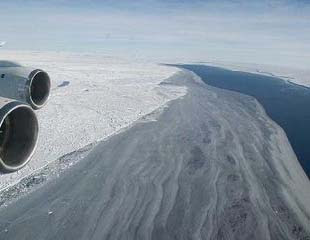
NASA researchers flying low over Antarctica’s vast, frozen landscape recently stumbled across a rare event in progress: the calving of a massive iceberg from one of Antarctica’s largest and fastest-moving glaciers. The scientists, who were taking part in NASA’s “Operation IceBridge,” were able to fly a follow-up mission above the Pine Island Glacier to gather unprecedented airborne measurements of an ongoing iceberg calving event. Typically, scientists can only learn of such events after they take place.

Since 2009, NASA scientists have been flying research aircraft loaded with sophisticated sensing equipment above Antarctic and Arctic ice, providing crucial data on ice sheet dynamics. This data is of great interest to the climate science community, considering the massive sea level rise that would occur if land-based ice sheets were to rapidly melt in coming decades.

Numerous studies have been published in the past several years that have raised alarms about the accelerating pace of ice loss in West Antarctica and Greenland. Operation IceBridge is meant to fill data gaps caused by a lag between two different ice-tracking satellites, thereby keeping data flowing to inform ongoing studies.

According to NASA, the last significant Pine Island Glacier calving event took place in 2001. It’s estimated that this one, an 18-mile long crack in the ice that was first spotted on Oct. 14 by a NASA DC-8 crew, probably began to form back in early October. Pine Island Glacier terminates in the sea, and has an “ice tongue” that juts out into the water. This makes the ice vulnerable to melting due to both rising air and water temperatures, although this calving event may have been a largely natural occurrence.

Tourism Links


Read More