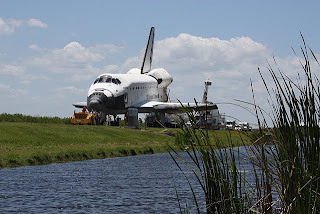
Showing posts with label Space Shuttle Endeavour. Show all posts

Endeavour Crew Talks With Hopkins Crowd

Endeavour Crew
The crew of the space shuttle Endeavour gathered at Johns Hopkins University on Thursday to talk about their experiences on one of NASA's final missions.

Endeavour lifted off for the International Space Station in May for the last time. It was the second to last flight for the space shuttle program.

Commander Mark Kelly, the husband of injured Arizona Rep. Gabrielle Giffords, led the talk with the panel of astronauts in front of a packed house.

"It's dark. It gets dark every 45 minutes," Kelly told the crowd. "We're really hopeful that we're going deliver some incredible discoveries to the American public and the people of the world, and it's going to prove to be a very valuable thing that we did in space."


"I think it's important, especially for my youngest son to understand that we really did go to space, and it was an important program," said mother Jennifer Leonard.

Read more:

Space shuttle Endeavour not expected to arrive in L.A. until late 2012

endeavour
The space shuttle Endeavour is expected to arrive at its permanent retirement home in Los Angeles in the latter half of 2012, the president of the California Science Center said Wednesday.

Initially, museum officials had said the shuttle could arrive by the end of this year. But NASA officials said it would take longer to detoxify the space shuttle and prepare it for retirement. Complicating the timeline was the delay in Endeavour's final mission and preparation for the upcoming mission of the shuttle Atlantis in July, which will mark the last voyage of the space shuttle program.

In the meantime, Jeffrey Rudolph, the California Science Center's president, said the museum, in Exposition Park, is making progress raising $28.8 million to pay for Endeavour's cleanup at the Kennedy Space Center in Florida and to bring it to Los Angeles.

"We're not there yet. But we're feeling good about it," Rudolph said of the fundraising effort.

Parsons, a global engineering firm based in Pasadena, is donating its services to cover the logistics of transporting the orbiter from LAX to the museum grounds. The orbiter will have to be routed on streets that are not obstructed by freeway overpasses, Rudolph said.

Rudolph said it would have been impractical for NASA to have Endeavour land at Edwards Air Force Base in California, because much of the equipment to detoxify the shuttle is in Florida.

Read More

Space Station Returns 3 Crew Members to Earth

Nasa
The International Space Station will release two astronauts and a Russian cosmonaut, returning them to earth tonight after more than five months living and working in orbit.

Russian cosmonaut Dmitry Kondratyev, Expedition 27 commander, and astronauts Catherine (Cady) Coleman of NASA and Paolo Nespoli of Italy will be landing their Russian-built Soyuz space capsule somewhere in Central Asia, probably on the steppes of Kazakhstan.

Kondratyev, Coleman and Nespoli will depart from the space station while the space shuttle Endeavour and its six-astronaut crew are docked at the orbiting laboratory. Endeavour is being retired following this, its last mission. The shuttle's team is half way through a 16-day mission to aid in the space station's day-to-day following the end of NASA's space shuttle program.

"I think we've done a lot of great science, and certainly I think the space station is in a really good state for the future," Coleman said, according to Space.com.

Read More

Nasa postpones Endeavour launch until 16 May

Endeavour launch
This is the latest in a series of delays since the shuttle's launch on 29 April was scrapped due to problems with its hydraulic systems. After the initial postponement, the agency targeted May 2, then May 8, and now mid-May at the earliest. Nasa managers have got to be worried that each subsequent delay is threatening the space shuttle programme's last ever launch, that of Atlantis, which is currently slated for 28 June.

"Kennedy [Space Center] technicians are continuing work to resolve an issue in a heater circuit associated with Endeavour's hydraulic system that resulted in the [April 29] launch postponement," Nasa said in a release on Friday. "Technicians determined the failure was inside an aft load control assembly, which is a switchbox in the shuttle's aft compartment, and possibly its associated electrical wiring."

Read More

Shuttle will launch no earlier than May 10

Space Shuttle Endeavour
Shuttle Endeavour won't set sail on its final flight before next Tuesday, May 10, at the earliest as Kennedy Space Center teams work to repair an electrical problem that scrubbed last Friday's launch attempt.

NASA had hoped a second attempt might be possible as soon as Sunday, but determined it would take about two more days than originally thought to ready the shuttle for another countdown.

"It became apparent Monday that more time was required," said Allard Beutel, a KSC spokesman.

Friday's launch scrubbed when heaters on a fuel line feeding part of the shuttle's hydraulic power system failed to turn on, a problem that could have led to a fire during flight.

Lightning Strikes Behind Shuttle Endeavour in Spectacular Photos

Nasa endeavour Lighting
A barrage of thunderstorms and lightning in Florida created a spectacular backdrop for the space shuttle Endeavour late Thursday in striking photos taken on the eve of the spacecraft's final launch.

The stunning snapshots show Endeavour atop the seaside Launch Pad 39A at NASA's Kennedy Space Center in Cape Canaveral, Fla., as bolts of lightning light up the cloud-filled sky above. For those brief instants, the lightning cast an eerie purple glow over the shuttle and launch pad. [Photo of Endeavour and lightning]

NASA photographer Bill Ingalls snapped the photos, which the space agency posted online, during a series of storms that temporarily stalled efforts by shuttle technicians to prepare Endeavour for its planned launch on Friday, April 29, at 3:47 p.m. EDT (1947 GMT).

Read More

NASA clears shuttle Endeavour for April 29 launch

Endeavour
The shuttle Endeavour was cleared for a launch attempt on April 29 to deliver a new class of physics instrument to the International Space Station on NASA's next-to-last shuttle flight, officials said Tuesday.

Liftoff of the 134th shuttle mission is scheduled for 3:47 p.m. EDT from the Kennedy Space Center in Florida.

The all-veteran crew is led by Mark Kelly, husband of Arizona Democratic Representative Gabrielle Giffords, who is recovering from a January 8 shooting that killed six people and injured 12 others.

Pending approval from her doctors, Giffords, who has not been seen publicly since the attack outside a Tucson, Arizona, grocery store, plans to attend the launch, Kelly has said.

The primary purpose of the flight is to deliver the $2 billion Alpha Magnetic Spectrometer, or AMS, particle detector, an instrument designed to detect dark matter, antimatter and other exotic phenomena.

"It has the potential of returning really Earth-shattering science," said NASA's Bill Gerstenmaier.

A team of 600 scientists from 16 nations, including China and Taiwan, are partners in the project.

After installing AMS the Endeavour astronauts will turn their attention to four spacewalks and other tasks to help get the space station ready for operations without shuttle support. The station is a $100 billion project of the United States, Russia, Europe, Japan and Canada that has been under construction since 1998, 220 miles above Earth.

Read More

Hubble Data Used to Look 10,000 Years into the Future

he globular star cluster Omega Centauri has caught the attention of sky watchers ever since the ancient astronomer Ptolemy first catalogued it 2,000 years ago. Ptolemy, however, thought Omega Centauri was a single star. He didn't know that the "star" was actually a beehive swarm of nearly 10 million stars, all orbiting a common center of gravity.

The stars are so tightly crammed together that astronomers had to wait for the powerful vision of NASA's Hubble Space Telescope to peer deep into the core of the "beehive" and resolve individual stars. Hubble's vision is so sharp it can even measure the motion of many of these stars, and over a relatively short span of time.

A precise measurement of star motions in giant clusters can yield insights into how stellar groupings formed in the early universe, and whether an "intermediate mass" black hole, one roughly 10,000 times as massive as our Sun, might be lurking among the stars.

Analyzing archived images taken over a four-year period by Hubble's Advanced Camera for Surveys, astronomers have made the most accurate measurements yet of the motions of more than 100,000 cluster inhabitants, the largest survey to date to study the movement of stars in any cluster.

Discovery and Payload at Launch pad


Space shuttle Discovery's payload for its STS-133 mission to the International Space Station is at Launch Pad 39A where workers will load it into the shuttle's payload bay. Discovery will carry the Permanent Multipurpose Module to the station during the upcoming mission. The module, which will remain attached to the station after Discovery leaves, is loaded with spare equipment, experiments, supplies and Robonaut 2, the first humanoid robot to go into space. Launch is targeted for Nov. 1 at 4:40 p.m. EDT.

Soyuz Moved to Pad for Thursday Launch to Station


The Soyuz spacecraft that will carry three new Expedition 25 flight engineers to the International Space Station was rolled out to the launch pad at the Baikonur Cosmodrome in Kazakhstan on Tuesday. NASA astronaut Scott Kelly and Russian cosmonauts Alexander Kaleri and Oleg Skripochka will launch aboard the new Soyuz TMA-01M Thursday at 7:10 p.m. EDT (Friday, Kazakhstan time) and begin a five-month tour of duty aboard the station after docking to the Poisk module Saturday evening.

Meanwhile, the three Expedition 25 crew members already living and working aboard the station conducted a depressurization drill, collected data for science research and prepared for the installation of a device to produce water.

Commander Doug Wheelock began his workday early by participating in the Pro K experiment, which studies dietary countermeasures to lessen the bone loss experienced by astronauts during long-duration spaceflight. With assistance from Flight Engineer Shannon Walker, Wheelock collected a blood sample and stored it in the Minus Eighty-Degree Laboratory Freezer for ISS for study later by scientists back on Earth.

space shuttle Discovery's final spaceflight


During space shuttle Discovery's final spaceflight, the STS-133 crew members will take important spare parts to the International Space Station along with the Express Logistics Carrier-4. Discovery has been moved to Launch Pad 39A at NASA's Kennedy Space Center in Florida. STS-133 is slated to launch Nov. 1.

NASA Kennedy Space Center's Launch Pad 39A, work continues to prepare space shuttle Discovery for its STS-133 mission, targeted to launch Nov. 1 at 4:40 p.m. EDT. Technicians have completed prelaunch propellant servicing operations, and the mission's payload -- the Permanent Multipurpose Module, Express Logistics Carrier 4 and an array of spare hardware -- is set to be installed Thursday inside Discovery's payload bay.

The six-person STS-133 astronaut crew will practice procedures for the missions first spacewalk today in NASA Johnson Space Center's Neutral Buoyancy Laboratory.

Leak Checks for Discovery Today

Technicians will conduct leak checks today on the quick disconnects for space shuttle Discovery's forward reaction control system and auxiliary power units. The shuttle is at Launch Pad 39A at NASA's Kennedy Space Center in Florida, the launch site of all the shuttle missions.

At NASA's Johnson Space Center in Houston, training home to the astronauts, the STS-133 crew will practice procedures in the Neutral Buoyancy Laboratory for the mission's first spacewalk.

Observe the Moon


The moon is the Earth's nearest celestial neighbor and a geologic wonderland. There are mountains that are many miles high, lava flows several hundred miles long and enormous lava tubes and craters of every size. It is the brightest object in the night sky and has profoundly influenced the course of human civilization.

For early humans, the moon provided lighting for hunting and defined when crops should be planted and harvested. Markings of lunar phases appear in cave paintings in France and defined the arrangement of Stonehenge.

The 2010 International "Observe the Moon Night" is happening on Saturday, Sept. 18. On Thursday, Sept. 16, at 3:00 p.m. EDT, Dr. Rob Suggs of NASA's Marshall Space Flight Center in Huntsville, Ala., will answer your questions about the moon and National Observe the Moon Night. Joining the chat is easy. Simply return to this page a few minutes before the chat time on Thursday. The chat module will appear at the bottom of this page. After you log in, wait for the chat module to be activated at 3:00, then ask your questions!

A Snapshot of Sea Ice


How does the Aqua satellite "see" sea ice? Microwaves. Everything on Earth’s surface -- including people -- emits microwave radiation, the properties of which vary with the emitter, thereby allowing the AMSR-E microwave sensor on Aqua to map the planet.

Ice emits more microwave radiation than water, making regions of the ocean with floating ice appear much brighter than the open ocean to the AMSR-E sensor. This difference allows the satellite to capture a sea ice record year-round, through cloud cover and the months of polar night. Continuous records are important because sea ice is dynamic. Besides melting and freezing, the ice moves with wind and currents which can cause it to split or pile up.

"The data from AMSR-E and other NASA satellites are critical for understanding the coupling between sea ice and the ocean and atmosphere," said Tom Wagner, Cryosphere program manager at NASA Headquarters in Washington. "It’s important for us to understand these connections to improve our predictive models of how the planet will change."

Cassini Captures a Divine Dione

Cruising past Saturn's moon Dione this past weekend, NASA's Cassini spacecraft got its best look yet at the north polar region of this small, icy moon and returned stark raw images of the fractured, cratered surface.

The new images also show new views of the long, bright canyon ice walls, which scientists working with NASA's Voyager spacecraft called "wispy terrain" in the early 1980s. These ice walls thread along the surface of the moon's trailing hemisphere and cut across craters.

The Cassini-Huygens mission is a cooperative project of NASA, the European Space Agency and the Italian Space Agency. JPL, a division of the California Institute of Technology in Pasadena, manages the mission for NASA's Science Mission Directorate, Washington, D.C. The Cassini orbiter and its two onboard cameras were designed, developed and assembled at JPL. The imaging operations center is based at the Space Science Institute in Boulder, Colo.

Magnetospheric Mission Passes Major Milestone


On the sun, magnetic reconnection causes solar flares more powerful than several atomic bombs combined. In Earth's atmosphere, magnetic reconnection dispenses magnetic storms and auroras, and in laboratories on Earth it can cause big problems in fusion reactors.

Although the study of magnetic reconnection dates back to the 1950s and despite numerous scientific papers addressing this perplexing issue, scientists still cannot agree on one accepted model.

In 2014, NASA is scheduled to launch a satellite that will greatly increase our understanding of this phenomenon when it launches the Magnetospheric Multiscale (MMS) mission, a suite of four identical spacecraft that will study magnetic reconnection in the best possible laboratory – the Earth’s magnetosphere. The spacecraft will obtain measurements necessary to test prevailing theories as to how reconnection is enabled and how it progresses.

Kepler Mission Discovers Two Planets Transiting the Same Star


Kepler spacecraft has discovered the first confirmed planetary system with more than one planet crossing in front of, or transiting, the same star.

The transit signatures of two distinct planets were seen in the data for the sun-like star designated Kepler-9. The planets were named Kepler-9b and 9c. The discovery incorporates seven months of observations of more than 156,000 stars as part of an ongoing search for Earth-sized planets outside our solar system. The findings will be published in Thursday's issue of the journal Science.

Kepler's ultra-precise camera measures tiny decreases in the stars' brightness that occur when a planet transits them. The size of the planet can be derived from these temporary dips.

The distance of the planet from the star can be calculated by measuring the time between successive dips as the planet orbits the star. Small variations in the regularity of these dips can be used to determine

Station Crew Busy With Science and Maintenance

The Expedition 24 crew members were busy with a variety of science experiments and maintenance activities Wednesday as they orbited the Earth aboard the International Space Station.

In the Japanese Kibo module, Flight Engineer Doug Wheelock set up equipment in the Fluid Physics Experiment Facility for a study of the Marangoni effect, which is the flow of liquids caused by surface tension.

Flight Engineer Tracy Caldwell Dyson changed out hardware and removed samples from the Multi-user Droplet Combustion Apparatus, which is part of the Combustion Integrated Rack (CIR) in the U.S. Destiny laboratory. The CIR is an experiment facility that helps researchers study how different materials combust in the microgravity environment aboard the station and can be operated by crew members or remotely by researchers on Earth.

Flight Engineer Shannon Walker analyzed water samples from the station’s Water Recovery System.

Spacecraft to Safe, Distant Landings

NASA is developing technologies that will allow landing vehicles to automatically identify and navigate to the location of a safe landing site while detecting landing hazards during the final descent to the surface. This is important because future missions -- whether to the Moon, an asteroid, Mars or other location -- will need this capability to land safely near specific resources that are located in potentially hazardous terrain.

Langley Research Center, Hampton, Va., has designed three light detection and ranging (lidar) sensors that together can provide all the necessary data for achieving safe autonomous precision landing.

One is a three-dimensional active imaging device, referred to as flash lidar, for detecting hazardous terrain features and identifying safe landing sites. The second is a Doppler lidar instrument for measuring the vehicle velocity and altitude to help land precisely at the chosen site. The third is a high-altitude laser altimeter providing data prior to final approach for correcting the flight trajectory towards the designated landing area.

Galaxies' Glory Days Revealed

Astronomers have experienced the galactic equivalent of discovering pictures of a mild-mannered grandmother partying as a wild youth. New observations from NASA's Spitzer Space Telescope reveal the early "wild" days of galaxy clusters -- a time when the galaxies were bursting with new stars.

What is particularly striking is the fact that the stellar birth rate is higher in the cluster's center than at its edges -- the exact opposite of what happens in our local portion of the universe, where the cores of galaxy clusters are known to be galactic graveyards.

The discovery, made by an international team of researchers led by Kim-Vy Tran of Texas A&M University, College Station, could ultimately reveal more about how such massive galaxies form.

Tran and her team spent the past four months analyzing images taken by Spitzer, essentially looking back in time nearly 10 billion years at a distant galaxy cluster known as CLG J02182-05102. Mere months after first discovering the cluster and the fact that it is shockingly "modern" in its appearance and size for its age, the team was able to determine that the galaxy cluster produces hundreds to thousands of new stars every year. That is a far higher birth rate than that of galaxies relatively near to us.