The Deep Impact mission


The Deep Impact mission was planned to help answer fundamental questions about comets, which included what makes up the composition of the comet's nucleus, what depth the crater would reach from the impact, and where the comet originated in its formation. By observing the composition of the comet, astronomers hoped to determine how comets form based on the differences between the interior and exterior makeup of the comet. Observations of the impact and its aftermath would allow astronomers to attempt to determine the answers to these questions.
The probe was originally scheduled for launch on December 30, 2004, but NASA officials delayed its launch, in order to allow more time for testing the software. It was successfully launched from Cape Canaveral on January 12, 2005 at 1:47 p.m. EST (1847 UTC) by a Delta 2 rocket.
Deep Impact's state of health was uncertain during the first day after launch. Shortly after entering orbit around the Sun and deploying its solar panels, the probe switched itself to safe mode. The cause of the problem was simply an incorrect temperature limit in the fault protection logic for the spacecraft's RCS thruster catalyst beds. The spacecraft's thrusters were used to detumble the spacecraft following third stage separation. NASA subsequently announced that the probe was out of safe mode and healthy.


NASA updates space shuttle target launch dates for two flights


NASA is targeting 4:50 p.m. EST on Thursday, Feb. 24, for the launch of space shuttle Discovery's STS-133 mission to the International Space Station. The liftoff of shuttle Endeavour's STS-134 flight is planned for 7:48 p.m. EDT on April 19, from NASA's Kennedy Space Center in Florida.
The target dates were selected Thursday during the Space Shuttle Program's weekly Program Requirements Control Board meeting.
NASA sets official launch dates for each shuttle mission following agency Flight Readiness Reviews, which typically occur about two weeks prior to launches. All target launch dates are subject to change.

Launch
Target

Assembly
Flight

Launch
Vehicle

Element(s)

Jan. 20, 2011

H-II Transfer Vehicle (HTV)

HTV2

Logistics and resupply

Jan. 28, 2011

41P

ISS Progress 41

Logistics and resupply

Feb. 24, 2011

ULF5

Discovery
STS-133

EXPRESS Logistics Carrier 4 (ELC4)

Permanent Multi-Purpose Module (PMM)

Feb. 15, 2011

ATV-2

Ariane 5

Logistics and resupply

March 29, 2011

26S

Soyuz TMA-21
Expedition 27

Crew transport

April 19, 2011

ULF6

Endeavour
STS-134

EXPRESS Logistics Carrier 3 (ELC3)Alpha Magnetic Spectrometer (AMS)

December 2011

3R

Russian Proton

Multipurpose Laboratory Module with European Robotic Arm (ERA)

NASA telescopes help identify most distant galaxy cluster


A team of astronomers has uncovered a burgeoning galactic metropolis, the most distant known in the early universe. This ancient collection of galaxies presumably grew into a modern galaxy cluster similar to the massive ones seen today.

The developing cluster, named COSMOS-AzTEC3, was discovered and characterized by multiwavelength telescopes, including NASA’s Spitzer, Chandra and Hubble space telescopes, and the ground-based W.M. Keck Observatory and Japan’s Subaru Telescope.

Johannes Staguhn, an associate research scientist at Johns Hopkins’ Center for Astrophysical Sciences in the Krieger School’s Henry A. Rowland Department of Physics and Astronomy, contributed data to uncover the nature of a main cluster member.

“This exciting discovery showcases the exceptional science made possible through collaboration among NASA projects and our international partners,” said Jon Morse, NASA’s Astrophysics Division director at NASA Headquarters in Washington, D.C.

Scientists refer to this growing lump of galaxies as a proto-cluster. COSMOS-AzTEC3 is the most distant massive proto-cluster known and also one of the youngest, because it is being seen when the universe itself was young. The cluster is roughly 12.6 billion light-years away from Earth. Our universe is estimated to be 13.7 billion years old. Previously, more mature versions of these clusters had been spotted at 10 billion light-years away.

NASA Spacecraft Tracks Raging Saturn Storm


A powerful electrical storm is currently blasting across the planet. According to NASA, this is primarily an electrical storm with lightning bolts 10,000 times more powerful than those on Earth. NASA's Cassini spacecraft is currently trolling our solar system and captured the image of the storm. The satellite is currently on a five-month mission to monitor Saturn and its moons.
This storm is about the size of the planet Earth! Saturn's electrical storms do look a lot like our Earth-bound thunderstorms, but they are much larger. Storms on Saturn are thousands of miles wide. Their lightning bolts produce radio signals thousands of times more powerful than those produced by our thunderstorms.
According to NASA: "Lightning flashes within the persistent storm produce radio waves called electrostatic discharges." The Cassini Satellite first detected these discharges on Nov. 27, 2007. The storm itself was spotted by Cassini's cameras on Decmber 6th.
How long do these storms last? "The electrostatic radio outbursts have waxed and waned in intensity for five months now," said NASA Official George Fischer, "We saw similar storms in 2004 and 2006 that each lasted for nearly a month, but this storm is longer-lived by far."
A NASA press release adds: "The new storm is located in Saturn's southern hemisphere--in a region nicknamed "Storm Alley" by mission scientists--where the previous lightning storms were observed by Cassini."

NASA Throws Cash at Suborbital Flight, Piggybacking on Space Tourism


NASA's previous solicitations for proposals have covered advanced aerospace and space-bound technologies, as well as cheap, quiet future commercial jets. The latest proposal, from the Flight Opportunities Program under the Office of the Chief Technologist, is a little different: It's all about getting technology and test experiments into microgravity on the cheap, by shooting them into sub-orbital space at about 60 miles up rather than into orbit.

The Flight Opportunities program is specifically designed to boost the development of the new commercial space business in the U.S., which is being led by consumer-carrying companies such as Virgin Galactic and bigger business efforts like SpaceX. Virgin, along with a number of still rather mysterious companies, like Jeff Bezo's Blue Origin, is aiming at flying paying passengers into suborbital space inside a handful of years--and it seems this new NASA proposal is aimed squarely at the spacecraft of these companies.

The benefits of having frequent, reliable, low-cost access to microgravity via these third parties are obvious for NASA--it can test and re-test various technological tricks and fixes on a much more frequent and cheap basis than having to launch its own expensive sounding rockets. The quick turnaround times between commercial flights could even allow for near real-time fixes and adjustments to be made.

NASA Telescopes Help Find Most Distant Galaxy Cluster

Astronomers have uncovered a burgeoning galactic metropolis, the most distant known in the early universe. This ancient collection of galaxies presumably grew into a modern galaxy cluster similar to the massive ones seen today.

The developing cluster, named COSMOS-AzTEC3, was discovered and characterized by multi-wavelength telescopes, including NASA's Spitzer, Chandra and Hubble space telescopes, and the ground-based W.M. Keck Observatory and Japan's Subaru Telescope.

"This exciting discovery showcases the exceptional science made possible through collaboration among NASA projects and our international partners," said Jon Morse, NASA's Astrophysics Division director at NASA Headquarters in Washington.

Scientists refer to this growing lump of galaxies as a proto-cluster. COSMOS-AzTEC3 is the most distant massive proto-cluster known, and also one of the youngest, because it is being seen when the universe itself was young. The cluster is roughly 12.6 billion light-years away from Earth. Our universe is estimated to be 13.7 billion years old. Previously, more mature versions of these clusters had been spotted at 10 billion light-years away.


Planck Mission Peels Back Layers of the Universe


The Planck mission released a new data catalogue Tuesday from initial maps of the entire sky. The catalogue includes thousands of never-before-seen dusty cocoons where stars are forming, and some of the most massive clusters of galaxies ever observed. Planck is a European Space Agency mission with significant contributions from NASA.

"NASA is pleased to support this important mission, and we have eagerly awaited Planck's first discoveries," said Jon Morse, NASA's Astrophysics Division director at the agency's headquarters in Washington. "We look forward to continued collaboration with ESA and more outstanding science to come."

Planck launched in May 2009 on a mission to detect light from just a few hundred thousand years after the Big Bang, an explosive event at the dawn of the universe approximately 13.7 billion years ago. The spacecraft's state-of-the-art detectors ultimately will survey the whole sky at least four times, measuring the cosmic microwave background, or radiation left over from the Big Bang. The data will help scientists decipher clues about the evolution, fate and fabric of our universe. While these cosmology results won't be ready for another two years or so, early observations of specific objects in our Milky Way galaxy, as well as more distant galaxies, are being released.


AIM-Aeronomy of Ice in the Mesosphere

The Aeronomy of Ice in the Mesosphere (AIM) satellite mission is exploring Polar Mesospheric Clouds (PMCs), also called noctilucent clouds, to find out why they form and why they are changing.

The AIM mission has been extended by NASA through the end of FY12. During this time the instruments will monitor noctilucent clouds to better understand their variability and possible connection to climate change. Individual instrument data collection status, as well as spacecraft and instrument health, will be monitored throughout the life of the mission and reported periodically

The Aeronomy of Ice in the Mesosphere (AIM) is a satellite to conduct a 26-month study of noctilucent clouds (NLCs). It is ninetieth Explorer program mission and is part of the NASA-funded Small Explorer program (SMEX). On April 25, 2007 AIM was boosted into a 600 km (370 mi) high polar orbit by a Pegasus-XL rocket, which was air-launched from the Lockheed L-1011 Stargazer aircraft operated by Orbital Sciences.

The noctilucent clouds AIM is to study, also known as polar mesospheric clouds, occur in the Earth's atmosphere at altitudes of roughly 80 kilometers (50 mi) above the surface, far higher than other clouds. The AIM mission will help determine what factors — temperature, water vapor, and dust particles — lead to the formation of these clouds. The clouds seem to be a relatively recent phenomenon: they were first seen in 1885, and lately seem to be occurring more frequently.

NASA'S Kepler Mission Discovers Its First Rocky Planet


NASA's Kepler mission confirmed the discovery of its first rocky planet, named Kepler-10b. Measuring 1.4 times the size of Earth, it is the smallest planet ever discovered outside our solar system.

The discovery of this so-called exoplanet is based on more than eight months of data collected by the spacecraft from May 2009 to early January 2010.

"All of Kepler's best capabilities have converged to yield the first solid evidence of a rocky planet orbiting a star other than our sun," said Natalie Batalha, Kepler's deputy science team lead at NASA's Ames Research Center in Moffett Field, Calif., and primary author of a paper on the discovery accepted by the Astrophysical Journal. "The Kepler team made a commitment in 2010 about finding the telltale signatures of small planets in the data, and it's beginning to pay off."

Kepler's ultra-precise photometer measures the tiny decrease in a star's brightness that occurs when a planet crosses in front of it. The size of the planet can be derived from these periodic dips in brightness. The distance between the planet and the star is calculated by measuring the time between successive dips as the planet orbits the star.

Kepler is the first NASA mission capable of finding Earth-size planets in or near the habitable zone, the region in a planetary system where liquid water can exist on the planet's surface. However, since it orbits once every 0.84 days, Kepler-10b is more than 20 times closer to its star than Mercury is to our sun and not in the habitable zone.

Extreme Planet Makeover

The "Extreme Planet Makeover" on the NASA/JPL PlanetQuest site lets you roll up your sleeves and create your very own planet.

Balance five factors to create an Earth-like habitable world, or get wild and make your own extreme exoplanet. Use the Image Gallery feature to compare your creation with those of other Earthlings. Once you've finished creating the exoplanet of your dreams, download a picture of your custom world for posterity.


NASA Chat: The Quest for Planets

A new planet discovery will be announced Monday Jan. 10 during the 'Exoplanets & Their Host Stars' presentation at the American Astronomical Society (AAS) conference in Seattle, Washington.

Kepler is NASA's first mission to look specifically for Earth-size planets in the habitable zones (areas where liquid water could exist) around stars like our sun. Kepler will spend 3-1/2 years surveying more than 100,000 stars in the Cygnus-Lyra region of our Milky Way galaxy. More than 300 exoplanets have been discovered previously, most of which are low-density gas giants such as Jupiter or Saturn in our own solar system.

Natalie Batalha of the NASA Kepler Mission Team will be online answering your questions about this new planet finding on Monday, Jan. 10 from 3:30 p.m. to 4:30 p.m. EST / 12:30 p.m. to 1:30 p.m. PST. Natalie will be chatting with you live from the conference in Seattle.

Joining the chat is easy. Simply visit this page on Monday from 3:30 p.m. to 4:30 p.m. EST / 12:30 p.m. to 1:30 p.m. PST. The chat window will open at the bottom of this page starting 15 minutes before the chat. You can log in and be ready to ask questions at 3:30 p.m.


NASA Research Team Reveals Moon Has Earth-Like Core

State-of-the-art seismological techniques applied to Apollo-era data suggest our moon has a core similar to Earth's.

Uncovering details about the lunar core is critical for developing accurate models of the moon's formation. The data sheds light on the evolution of a lunar dynamo -- a natural process by which our moon may have generated and maintained its own strong magnetic field.

The team's findings suggest the moon possesses a solid, iron-rich inner core with a radius of nearly 150 miles and a fluid, primarily liquid-iron outer core with a radius of roughly 205 miles. Where it differs from Earth is a partially molten boundary layer around the core estimated to have a radius of nearly 300 miles. The research indicates the core contains a small percentage of light elements such as sulfur, echoing new seismology research on Earth that suggests the presence of light elements -- such as sulfur and oxygen -- in a layer around our own core.

The researchers used extensive data gathered during the Apollo-era moon missions. The Apollo Passive Seismic Experiment consisted of four seismometers deployed between 1969 and 1972, which recorded continuous lunar seismic activity until late-1977.

Andromeda is So Hot 'n' Cold


This mosaic of the Andromeda spiral galaxy highlights explosive stars in its interior, and cooler, dusty stars forming in its many rings. The image is a combination of observations from the Herschel Space Observatory taken in infrared light (seen in orange hues), and the XMM-Newton telescope captured in X-rays (seen in blues). NASA plays a role in both of these European Space Agency-led missions.

Herschel provides a detailed look at the cool clouds of star birth that line the galaxy's five concentric rings. Massive young stars are heating blankets of dust that surround them, causing them to glow in the longer-wavelength infrared light, known as far-infrared, that Herschel sees.

In contrast, XMM-Newton is capturing what happens at the end of the lives of massive stars. It shows the high-energy X-rays that come from, among other objects, supernova explosions and massive dead stars rotating around companions. These X-ray sources are clustered in the center of the galaxy, where the most massive stars tend to form.

Andromeda is our Milky Way galaxy's nearest large neighbor. It is located about 2.5 million light-years away and holds up to an estimated trillion stars. Our Milky Way is thought to contain about 200 billion to 400 billion stars.


Rover Will Spend 7th Birthday at Stadium-Size Crater


The High Resolution Imaging Science Experiment (HiRISE) camera on NASA's Mars Reconnaissance Orbiter captured a Dec. 31, 2010, view of the Mars Exploration Rover Opportunity on the southwestern rim of a football-field-size crater called "Santa Maria."

Opportunity arrived at the western edge of Santa Maria crater in mid-December and will spend about two months investigating rocks there. That investigation will take Opportunity into the beginning of its eighth year on Mars. Opportunity landed in the Meridiani Planum region of Mars on Jan. 25, 2004, Universal Time (Jan. 24, Pacific Time) for a mission originally planned to last for three months.


Bob Benson: Tales of Chilly Research

As the weather gets colder in Maryland, Bob Benson tells tales of winters he used to know in Minnesota, the South Pole, and Alaska. A five-decade career studying Earth's ionosphere – the part of Earth's atmosphere that reflects radio communication waves – has taken him to some extreme latitudes.

Standing in the corner of Bob Benson's office is a microfilm reader. You know, the big, boxy machine that was used to look up archived newspaper articles before such things were an Internet search away. That machine is one of the tools Benson has used to scan decades worth of data throughout his 46 years at NASA’s Goddard Space Flight Center in Greenbelt, Md. He studies the ionosphere – the swath of our atmosphere filled with electrons and ions stretching from about 30 to 600 miles above Earth's surface – and the data he studied from various ionospheric satellites were displayed on 35-millimeter film.

"We had thousands of these boxes," he says, holding up a small cardboard box in which a film lies curled. "When I first came here, we'd go pull them from a drawer at the National Space Science Data Center at Goddard and do analysis with a machine like this."


Discovery External Tank Repairs Begin Monday as Engineers Analyze Data

Technicians working on space shuttle Discovery's external fuel tank in the Vehicle Assembly Building at NASA's Kennedy Space Center in Florida are off for the New Year holiday weekend. On Monday, they'll begin repairs on three support beams, called stringers, that recently were detected to have small cracks on their tops.

Engineers at various NASA centers continue to analyze data from testing and X-ray type image scans collected during the past week of all 108 stringers on the outside of the external tank's ‪intertank section. The image scans showed four small cracks on three stringers on the opposite side of the tank from Discovery. Managers decided Thursday to have those cracks repaired in a similar fashion to repairs made on cracks on two stringers found after Discovery's Nov. 5 launch attempt.

The repair work is estimated to take 2–3 days. Any further work will be evaluated thoroughly during the week after additional data and analysis are reviewed.

Managers also continue to evaluate an option to perform known and practiced modifications on some stringers. Before breaking for the holiday, technicians reconfigured scaffolding to provide access for the modification work, should it be required. A decision may be made on that work as early as Monday.


View this site boat building, boat builders, wood preservative, construction marine, marine contractors

Free NASA Apps for iPhone, iPad Available


The NASA App for iPhone, iPod touch and iPad, combines all of your favorite NASA images, videos, missions and information into one, easy-to-use, application. It's available free of charge on the App Store from Apple directly on iPhone, iPod touch and iPad or within iTunes.

Cassini Celebrates 10 Years Since Jupiter Encounter


Ten years ago, on Dec. 30, 2000, NASA's Cassini spacecraft made its closest approach to Jupiter on its way to orbiting Saturn. The main purpose was to use the gravity of the largest planet in our solar system to slingshot Cassini towards Saturn, its ultimate destination. But the encounter with Jupiter, Saturn's gas-giant big brother, also gave the Cassini project a perfect lab for testing its instruments and evaluating its operations plans for its tour of the ringed planet, which began in 2004.

"The Jupiter flyby allowed the Cassini spacecraft to stretch its wings, rehearsing for its prime time show, orbiting Saturn," said Linda Spilker, Cassini project scientist based at NASA's Jet Propulsion Laboratory in Pasadena, Calif. "Ten years later, findings from the Jupiter flyby still continue to shape our understanding of similar processes in the Saturn system."

Cassini spent about six months - from October 2000 to March 2001 - exploring the Jupiter system. The closest approach brought Cassini to within about 9.7 million kilometers (6 million miles) of Jupiter's cloud tops at 2:05 a.m. Pacific Time, or 10:05 a.m. UTC, on Dec. 30, 2000.


SOHO Spots 2000th Comet


As people on Earth celebrate the holidays and prepare to ring in the New Year, an ESA/NASA spacecraft has quietly reached its own milestone: on December 26, the Solar and Heliospheric Observatory (SOHO) discovered its 2000th comet.

Drawing on help from citizen scientists around the world, SOHO has become the single greatest comet finder of all time. This is all the more impressive since SOHO was not specifically designed to find comets, but to monitor the sun.

"Since it launched on December 2, 1995 to observe the sun, SOHO has more than doubled the number of comets for which orbits have been determined over the last three hundred years," says Joe Gurman, the U.S. project scientist for SOHO at NASA's Goddard Space Flight Center in Greenbelt, Md.

NASA's AMAZING YEAR OF EXPLORATION

NASA in 2010 set a new course for human spaceflight, helped rewrite science textbooks, redefined our understanding of Earth’s nearest celestial neighbor, put the finishing touches on one of the world's greatest engineering marvels, made major contributions to life on Earth, and turned its sights toward the next era of exploration.

"This year, NASA’s work made headlines around the world, " NASA Administrator Charles Bolden said. "More importantly, it enlarged our understanding of the universe and our home planet, inspired people, and opened new frontiers for our dreams and aspirations."

"NASA achievements this year across the spectrum -- from science, to aeronautics, education and human spaceflight - provided incredible value to our nation, "NASA Deputy Administrator Lori Garver said. "We continue to build upon our rich history, taking on new challenges and doing the things that no one else can do -- all for the benefit of humanity."


Opportunity Studying a Football-Field Size Crater

NASA's Mars Exploration Rover Opportunity reached a crater about the size of a football field—some 90 meters (295 feet) in diameter. The rover team plans to use cameras and spectrometers during the next several weeks to examine rocks exposed at the crater, informally named "Santa Maria."

A mosaic of image frames taken by Opportunity's navigation camera on Dec. 16 shows the crater's sharp rim and rocks ejected from the impact that had excavated the crater.

Opportunity completed its three-month prime mission on Mars in April 2004 and has been working in bonus extended missions since then. After the investigations at Santa Maria, the rover team plans to resume a long-term trek by Opportunity to the rim of Endeavour Crater, which is about 22 kilometers (14 miles) in diameter.


Cassini Marks Holidays With Dramatic Views of Rhea


Newly released for the holidays, images of Saturn's second largest moon Rhea obtained by NASA's Cassini spacecraft show dramatic views of fractures cutting through craters on the moon's surface, revealing a history of tectonic rumbling. The images are among the highest-resolution views ever obtained of Rhea.

The images, captured on flybys on Nov. 21, 2009 and March 2, 2010, can be found at http://www.nasa.gov/cassini, http://saturn.jpl.nasa.gov and http://ciclops.org .

"These recent, high-resolution Cassini images help us put Saturn's moon in the context of the moons' geological family tree," said Paul Helfenstein, Cassini imaging team associate, based at Cornell University, Ithaca, N.Y. "Since NASA's Voyager mission visited Saturn, scientists have thought of Rhea and Dione as close cousins, with some differences in size and density. The new images show us they're more like fraternal twins, where the resemblance is more than skin deep. This probably comes from their nearness to each other in orbit."

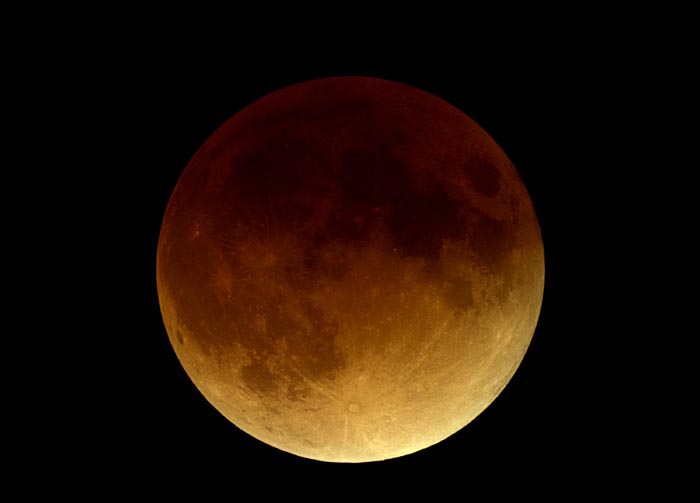
Total Lunar Eclipse: 'Up All Night' With NASA!

Lots of questions are coming in about the best times to view this around the world. Here's a summary from our astronomers below:

"Early in the morning on Dec. 21, a total lunar eclipse will be visible to sky watchers around the world. The eclipse is visible across all of North America -- for viewers in western states, the eclipse actually begins late in the evening of Dec. 20. Viewers in Greenland, Iceland and western Europe will be able to see the beginning stages of the eclipse before moonset. In western Asia, the later stages of the eclipse will be visible after moonrise. All of the eclipse will be visible throughout Mexico and Central America and northwest South America. Viewers in Peru, Chile and Bolivia will see most of the eclipse, but the moon will set before the end of the Penumbral phase. Viewers in Brazil will see the moon set during totality. Parts of Africa in the northwest will also see the moon set while it is eclipsed. All but the westernmost tip of Australia will see an eclipsed moon as it rises. Unfortunately most of Africa, the middle East and India will not have a view of this event. This map will help you determine the viewing in your area."


NASA's LRO Creating Unprecedented Topographic Map of Moon

NASA's Lunar Reconnaissance Orbiter is allowing researchers to create the most precise and complete map to date of the moon's complex, heavily cratered landscape.

"This dataset is being used to make digital elevation and terrain maps that will be a fundamental reference for future scientific and human exploration missions to the moon," said Dr. Gregory Neumann of NASA's Goddard Space Flight Center in Greenbelt, Md. "After about one year taking data, we already have nearly 3 billion data points from the Lunar Orbiter Laser Altimeter on board the LRO spacecraft, with near-uniform longitudinal coverage. We expect to continue to make measurements at this rate through the next two years of the science phase of the mission and beyond. Near the poles, we expect to provide near-GPS-like navigational capability as coverage is denser due to the spacecraft's polar orbit." Neumann will present the map at the American Geophysical Union meeting in San Francisco December 17.

A Galaxy for Everyone


This collage of galaxies from NASA's Wide-Field Infrared Survey Explorer, or WISE, showcases the many "flavors" that galaxies come in, from star-studded spirals to bulging ellipticals to those paired with other companion galaxies. The WISE team put this collage together to celebrate the anniversary of the mission's launch on Dec. 14, 2009.

After launch and a one-month checkout period, WISE began mapping the sky in infrared light. By July of this year, the entire sky had been surveyed, detecting hundreds of millions of objects, including the galaxies pictured here. In October of this year, after scanning the sky about one-and–a-half times, the spacecraft ran out of its frozen coolant, as planned. With its two shortest-wavelength infrared detectors still operational, the mission continues to survey the sky, focusing primarily on asteroids and comets.

NGC 300 is seen in the image in the upper left panel. This is a textbook spiral galaxy. In fact, it is such a good representation of a spiral galaxy that astronomers have studied it in great detail to learn about the structure of all spirals in general. Infrared images like this one from WISE show astronomers where areas of gas and warm dust are concentrated -- features that cannot be seen in visible light. At about 39,000 light-years across, NGC 300 is only about 40 percent the size of the Milky Way galaxy.


NASA's Odyssey Spacecraft Sets Exploration Record on Mars

NASA's Mars Odyssey, which launched in 2001, will break the record Wednesday for longest-serving spacecraft at the Red Planet. The probe begins its 3,340th day in Martian orbit at 5:55 p.m. PST (8:55 p.m. EST) on Wednesday to break the record set by NASA's Mars Global Surveyor, which orbited Mars from 1997 to 2006.

Odyssey's longevity enables continued science, including the monitoring of seasonal changes on Mars from year to year and the most detailed maps ever made of most of the planet. In 2002, the spacecraft detected hydrogen just below the surface throughout Mars' high-latitude regions. The deduction that the hydrogen is in frozen water prompted NASA's Phoenix Mars Lander mission, which confirmed the theory in 2008. Odyssey also carried the first experiment sent to Mars specifically to prepare for human missions, and found radiation levels around the planet from solar flares and cosmic rays are two to three times higher than around Earth.

Odyssey also has served as a communication relay, handling most of the data sent home by Phoenix and NASA's Mars Exploration Rovers Spirit and Opportunity. Odyssey became the middle link for continuous observation of Martian weather by NASA's Mars Global Surveyor and NASA's Mars Reconnaissance Orbiter.