Friction Stir Weld

Friction stir weld tack tool
This close-up view of the friction stir weld tack tool used to manufacture of space shuttle external tanks shows the process of tack welding barrel panels together. Barrels were previously fabricated using traditional fusion welding, but friction stir welding is different in that the materials are not melted. A rotating tool pin uses friction and applied pressure to join the 20-foot longitudinal panels together.

Friction stir welding is the most recent upgrade to the space shuttle's external tank, the largest element of the shuttle and the only element that is not reusable. The new welding technique utilizes frictional heating combined with forging pressure to produce high-strength bonds virtually free of defects. Friction stir welding transforms the metals from a solid state into a "plastic-like" state, and then mechanically stirs the materials together under pressure to form a welded joint. Invented and patented by The Welding Institute, a British research and technology organization, the process is applicable to aerospace, shipbuilding, aircraft and automotive industries. One of the key benefits of this new technology is that it allows welds to be made on aluminum alloys that cannot be readily fusion arc welded, the traditional method of welding.

Astronomers do it Again: Find Organic Molecules Around Gas Planet

This artist's concept shows a cloudy Jupiter-like planet that orbits very close to its fiery hot star
The basic chemistry for life has been detected in a second hot gas planet, HD 209458b, depicted in this artist's concept. Two of NASA's Great Observatories – the Hubble Space Telescope and Spitzer Space Telescope, yielded spectral observations that revealed molecules of carbon dioxide, methane and water vapor in the planet's atmosphere. HD 209458b, bigger than Jupiter, occupies a tight, 3.5-day orbit around a sun-like star about 150 light years away in the constellation Pegasus. Planets like this one, which circle stars beyond our sun, are called exoplanets.

The new finding follows the detection of these same organic molecules in the atmosphere of another hot, giant planet, called HD 189733b, by astronomers using Hubble and Spitzer data. Astronomers can now begin comparing the chemistry and dynamics of these two planets, and search for similar measurements of other candidate exoplanets, advancing toward the goal of being able to characterize planets where life could exist.

Neither of the two planets studied is habitable, but they display the same molecules that, if found around a rocky planet in the future, could potentially indicate the presence of life.

The new findings pave the way for future work that will help astronomers shortlist any promising rocky Earth-like planets where the signatures of organic chemicals might indicate the presence of life.

Q-and-A at the Pad

STS-129 crew at Launch Pad 39A
The STS-129 astronauts, while at NASA's Kennedy Space Center in Florida for a launch dress rehearsal, took the opportunity to speak with the media about their upcoming mission to the International Space Station.

Space shuttle Atlantis Pilot Barry E. Wilmore reflected on the first shuttle flight he'll be flying.

"I can't begin to put into words how it feels," Wilmore said. "After being an astronaut for nine years and it's just now become my turn to go … and how exciting it was to fly by yesterday, look down and see Atlantis on the pad... knowing that all the efforts around this nation that have gone into preparing this vehicle for our launch. We're proud to be the folks to sit on the pointy end of it and get to launch on it."

"I'd do backflips for you," Wilmore continued. "It's been a thrilling time and a thrilling moment for all of us, and certainly for me being a first-time flier."

Peppered among mission-related questions was one answered by Atlantis' Commander Charles O. Hobaugh about the Constellation Program's next-generation spacecraft.

"We're ready to take the next step when it happens. For us, where we're at right now... we're focused on getting this mission off and doing our best job to make sure it happens," Hobaugh said. "Once we get back we'll jump into whatever the Augustine commission and the current administration decides is the proper course for NASA to take in its next generation."

"We are very lucky to be a participant in the space program," Hobaugh continued. "It's part of the bigger national interest and also part of an international effort and wherever our piece fits in I think all of us are more than happy to do our best part to make sure it occurs in the best way possible."

While at Launch Pad 39A today, the crew will practice emergency pad egress and other related safety training. They will return to NASA's Johnson Space Center in Houston tomorrow and then conduct the remainder of the launch dress rehearsal training at Kennedy on Nov. 2 and 3.

Abbreviated TCDT at Kennedy

At NASA's Kennedy Space Center in Florida, space shuttle Atlantis' STS-129 mission astronauts will be traveling to Launch Pad 39A where they will practice emergency pad egress and other related safety training.

While at the pad, the crew will have a brief question-and-answer period with the media broadcast on NASA TV. The media event will begin at 9:40 a.m. EDT and can be accessed at www.nasa.gov/ntv.

In order to optimize NASA's ability to launch both Atlantis and the Constellation Program's Ares I-X flight test before the end of the year, the agency now is targeting Nov. 16 for the launch of Atlantis' STS-129 mission to the International Space Station. Therefore, the crew will cut this Terminal Countdown Demonstration Test, or TCDT, short and conduct the remainder of launch dress rehearsal training Nov. 2 and 3.

The same launch team at Kennedy is supporting both the shuttle and the Ares I-X flight test, which is targeted to lift off Oct. 27.

New Target Launch Date for Atlantis' STS-129 Mission

NASA is targeting Nov. 16 for the launch of space shuttle Atlantis' STS-129 mission from the agency's Kennedy Space Center in Florida.

Senior managers met Monday and decided to adjust Atlantis' target launch date to optimize the agency's ability to launch both Ares I-X and Atlantis before the end of the year. The same launch team at Kennedy is supporting both the shuttle and the flight test of the Ares I-X rocket, which is targeted to lift off on Oct. 27.

Atlantis' new target launch date will give Ares I-X launch opportunities Oct. 27, 28 and 29. NASA has yet to schedule Atlantis' new target liftoff date on the Eastern Range.

The change to Atlantis' targeted launch will affect the launch countdown dress rehearsal for the shuttle's six astronauts. The astronauts arrived at Kennedy on Monday for the Terminal Countdown Demonstration Test and related training. The simulated countdown has been rescheduled to Nov. 3. The astronauts will practice emergency escape and other related training while they are at Kennedy this week and return there Nov. 2 to conclude their rehearsal work.

The agency's Flight Readiness Review meeting for STS-129 is set for Oct. 29. NASA will schedule an official launch date for Atlantis at that meeting.

JPL Develops High-Speed Test to Improve Pathogen Decontamination

JPL Chemist Adrian Ponce prepares samples
A chemist at NASA's Jet Propulsion Laboratory in Pasadena, Calif., has developed a technology intended to rapidly assess any presence of microbial life on spacecraft. This new method may also help the military test for disease-causing bacteria, such as a causative agent for anthrax, and may also be useful in the medical, pharmaceutical and other fields.

Adrian Ponce, the deputy manager for JPL's planetary science section, devised the new microscope-based method, which has the potential to quickly validate -- from days to minutes -- a spacecraft's cleanliness.

NASA adheres to international protocols by striving to ensure that spacecraft don't harbor life from Earth that could contaminate other planets or moons and skew science research. Microbes known as bacterial endospores can withstand extreme temperatures, ultraviolet rays and chemical treatments, and have been known to survive in space for six years. This resilience makes them important indicators for cleanliness and biodefense, Ponce said.

"Bacterial endospores are the toughest form of life on Earth," Ponce explained. "Therefore, if one can show that all spores are killed, then less-resistant, disease-causing organisms will also be dead."

The new technology works by looking for dipicolinic acid -- a major component of endospores and evidence of endospore growth -- by first applying terbium to a dime-sized area. Terbium is a chemical element used to generate the color green on television screens. That area is then illuminated under an ultraviolet lamp. Within minutes, one can see through a microscope aided by a digital camera whether live endospores are present. That's because they will literally glow: The terbium will show the endospores as bright green spots.

Ponce co-authored a paper on the new technology, called Germinable Endospore Biodosimetry, along with Pun To Young, a post-doctoral student at the California Institute of Technology in Pasadena, in the journal Applied and Environmental Microbiology. The research was also highlighted in Microbe, a magazine of the American Society for Microbiology.

The technology has piqued the interest of the U.S. Department of Homeland Security. The federal agency is funding development of a portable instrument based on Ponce's research that could quickly check for decontamination of pathogens after a biological attack. Ponce is working with the Department of Homeland Security and Advance Space Monitor, a company based in Falls River, Mass., to develop the instrument, which they plan to have ready for use by 2011. JPL and Caltech licensed the technology to Advance Space Monitor.

"As part of the Department of Homeland Security Science and Technology Directorate's near-term bioassays effort, the technology could enable the rapid assessment of facility sterilization. This could significantly reduce the time and cost of building restoration following a bio-contamination event," said James Anthony, chemical and biological research and development program manager at the Dept. of Homeland Security. A bioassay is an assessment of whether certain biological material is present on a surface being tested.

Anthony added that the technology could also be used in bio-containment facilities that have regularly scheduled decontamination requirements and rapidly reactivate important bio-defense research facilities.

Besides outer space and defense purposes, this new technology might also be applied in hospitals, child-care centers, dentists' offices and nursing homes.

"Given all the problems with hospital-acquired infections, assessing the sterility and hygiene of medical equipment and surfaces is becoming increasingly important," said Ponce.

Funding for Ponce's project was provided by NASA's Astrobiology Science and Instrument Development Program and Mars Technology Program, and the U.S. Department of Homeland Security's Chemical and Biological Research and Development division.

Spirit's Robotic Stretch on Sol 2052

NASA's Mars Exploration Rover Spirit
NASA's Mars Exploration Rover Spirit recorded this forward view of its arm and surroundings during the rover's 2,052nd Martian day, or sol.

Bright soil in the left half of the image is loose, fluffy material churned by the rover's left-front wheel as Spirit, driving backwards, approached its current position in April 2009 and the wheel broke through a darker, crusty surface.

Spirit used its front hazard-avoidance camera to take this image. The turret of tools at the end of the rover's robotic arm is positioned with the Moessbauer spectrometer up and the rock abrasion tool extending toward the right. Spirit's right-front wheel, visible in this image, has not worked since 2006. It is the least-embedded of the rover's six wheels at the current location, called "Troy."

Spirit and its twin, Opportunity, have been working on Mars for more than 58 months in what were originally planned as three-month missions on Mars.

Fresh Rim of Slipher S


Distinctive asymmetrical ejecta surrounds a 140 meter (459 feet) diameter crater in the lunar highlands. The distinctive wave-like texture may look a little bit like a terrestrial beach, but it's actually impact ejecta on the rim of the crater Slipher S (26 km diameter), which is located on the lunar farside at the edge of the larger and older crater Slipher. Notice that there are only a few small craters dotting the surface, and so the rim is well preserved. To a lunar geologist, the lack of impact degradation on a surface like this one indicates a (relatively) young age, and in fact this crater is currently mapped as an Eratosthenian-aged crater. You are actually looking at some of the deepest materials excavated by this crater. When impact craters form, the rocks excavated from the deepest parts of the crater actually fall near the rim. In effect nature is providing a drill hole to the subsurface bringing deep rocks right to the surface.

Getz Ice Shelf

Getz Ice Shelf
On Oct. 16, Operation Ice Bridge researchers and crew completed the first flight of the Antarctic campaign. The flight was made from the southern tip of South America and its primary target was the Getz Ice Shelf along Antarctica's Amundsen Coast. During the flight along Amundsen Coast, the aircraft's downward-looking Digital Mapping System camera captured this image of sea ice from an altitude of at least 20,000 feet.

The DC-8 aircraft flew two parallel tracks along the coast, one just offshore over the floating ice shelf, and one just inland. By measuring on either side of the "grounding line" between the floating ice and the ice on land, scientists can determine the rate at which this near-shore part of the ice shelf is melting.

Ares I-X Secured at the Launch Pad

Ares I-X rocket at the launch pad
The Ares I-X now is secured on Launch Pad 39B at NASA's Kennedy Space Center in Florida. The test rocket, sitting on a mobile launcher platform, was “hard down” on the pad’s pedestals at 9:17 a.m. EDT. The rotating service structure is expected to be rolled into place at about 12:30 p.m.

Ground teams began rolling out Ares I-X and its launch platform aboard a crawler-transporter from Kennedy’s Vehicle Assembly Building at 1:39 a.m. It arrived at the pad about 7:45 a.m.

Managers will meet at Kennedy on Friday for a Flight Test Readiness Review to thoroughly discuss whether the flight test is ready to proceed and set an official launch date. Currently, Ares I-X is targeted to launch Oct. 27 at 8 a.m.

Launch Vehicle: Ares I-X
Targeted Launch Date: Oct. 27
Launch Window: 8 a.m. - 12 p.m. EDT
Launch Pad: 39B
Launch Site: Kennedy Space Center, Fla.

NASA's first flight test for the agency's next-generation spacecraft and launch vehicle system, called Ares I-X, will bring NASA one step closer to its exploration goals -- to return to the moon for more ambitious exploration of the lunar surface and to travel to Mars and destinations beyond. The flight test will provide NASA with an early opportunity to test and prove flight characteristics, hardware, facilities and ground operations associated with the Ares I.

GOES-P Satellite Preparing for Launch in March 2010

SAT Team at Boeing
Just two months after the successful launch of the GOES-O spacecraft, now called GOES-14 in orbit, the NASA team removed the GOES-P spacecraft from storage and commenced its post storage testing. GOES-P is being prepared for an early March 2010 launch and if the launch schedule holds, it boasts an unprecedented two launches in approximately 8 months.

The GOES-P spacecraft completed its build late in 2006 (just after the launch of GOES-N) and since that time the spacecraft has been in storage at the Boeing Facility in El Segundo, California.

NASA has a commitment, to the National Oceanic and Atmospheric Administration (NOAA), for the launch of the GOES-P spacecraft in April 2010. The combined NASA and contractor teams (Boeing, ITT and LM) are working hard to meet their commitment and are now preparing the GOES–P spacecraft for shipment to the launch base. The project has recently completed a major milestone in the completion of its instrument testing.

During this testing, the NASA team demonstrated the instruments continue to function as expected and will meet the stringent mission requirements. The instruments include the Imager and Sounder, built by ITT, and the Solar X-Ray Imager built by Lockheed Martin.

With these activities completed the spacecraft will continue the testing of the spacecraft subsystems and mechanical activities. NASA is looking forward to completing these activities and the ensuing launch campaign.

Fires Around Lake Malawi in Africa

Fires around Lake Malawi in Africa
Fires continued to burn around eastern Africa’s Lake Malawi (Lake Nyasa) on October 13, 2009. The Moderate Resolution Imaging Spectroradiometer (MODIS) on NASA’s Terra satellite captured this true-color image the same day. The fires were likely set for purposes of agriculture, a common occurrence at this time of year.

Red dots indicate hotspots associated with actively burning fires, which burn all around Lake Malawi. Beige-gray smoke plumes occupy a roughly east-west band through Zimbabwe and Mozambique, south of the lake. Although the smoke almost certainly results from the regional fires, only a few source points for smoke plumes appear in this image.

Timbuktu

Timbuktu, Mali
Timbuktu in the West African nation of Mali is at the intersection of an east-west and a north-south Trans Saharan trade route across the Sahara. The city-state was an intellectual and spiritual capital in the 15th and 16th centuries. After long years of decline, Timbuktu is still a tourist destination and is a UNESCO World Heritage Site.

This image was captured by the ASTER image aboard the Terra spacecraft. With its 14 spectral bands from the visible to the thermal infrared wavelength region and its high spatial resolution of 15 to 90 meters (about 50 to 300 feet), ASTER images Earth to map and monitor the changing surface of our planet. ASTER is one of five Earth-observing instruments launched December 18, 1999, on NASA's Terra satellite. The instrument was built by Japan's Ministry of Economy, Trade and Industry. A joint U.S./Japan science team is responsible for validation and calibration of the instrument and the data products.

The broad spectral coverage and high spectral resolution of ASTER provides scientists with critical information for surface mapping and monitoring of dynamic conditions and temporal change.

Smiles and Memories: A Final 'Goodbye' to the Langley Full-Scale Tunnel

A group of employees who worked in the Full-Scale Tunnel
It was a grand finale of sorts, a celebration that revisited the 78-year history of the Full-Scale Tunnel at NASA's Langley Research Center in Hampton, Va.

Engineers mingled with mayors. Alumni mingled with a new generation of NASA. Recollections mingled with respect.

"Many times it is referred to as 'the' Langley Wind Tunnel," said Joe Chambers, author and former tunnel branch head, who spoke to a standing room-only crowd at Langley's Reid Conference Center. In fact, it was only one of dozens of wind tunnels at NASA Langley.

A slideshow of the tunnel's history shown through photographs and quotes included music from the decades of the tunnel's operation. It set the ambiance for the ceremony that marked the official "goodbye." Demolition of the 30-by-60-foot tunnel is expected to begin early next year.

"We did 796 tests in this facility," said Chambers.

Chambers explained that the vision for a tunnel that would be 60 feet (18.3 m) across, 30 feet (9.1 m) high and with capabilities of speed surpassing 100 miles per hour (161 kph) started as a model in 1929. That model was under construction by 1930 and dedicated in 1931. It was built for $980,000.

As ideas arose, the tunnel evolved. In 1939, wooden blades replaced the original metal ones. "Those blades are the same blades that are in the tunnel today," Chambers said. Applause erupted.

During the years of the National Advisory Committee for Aeronautics, the tunnel attracted pioneers and luminaries like Orville Wright, Charles Lindbergh, Glenn Curtiss and Howard Hughes.

"When NASA was formed, the facility changed and began to develop space ideas," Chambers said. Modern times called for modern upgrades. Chambers noted the addition of a flight control computer.

And according to Chambers, the wind tunnel was producing more than just critical test results for improved flight -- it produced four NASA Center Directors. "There is no other wind tunnel or organization that provided four center directors to the agency," he said.

It also produced memories.

Gorden Helsel, mayor of Poquoson, Va., stared forward at the slideshow. "It's a landmark to this area," he said. "To a lot of folks out here, it's like losing an old friend."

He glanced over at the F-22 model. "I flew in one of those," Helsel said. "I spent 45 minutes in the air and was glad to get back on the ground." It was an experience made possible through testing at the full-scale tunnel.

Long Yip worked in the tunnel from 1977 to 1990. "I remember opening a textbook on aeronautics and the first thing I saw was the Full Scale Tunnel. I never imagined I would work there," he said.

Bob Huston began working at the tunnel in 1958. He recalled a time when one of his tests was interrupted by testing for Neil Armstrong and the lunar lander. "The test I was working on was delayed for six months," he said. In hindsight, Huston didn't mind so much.

Following the reception, many guests chose to revisit the tunnel located on the Langley Air Force Base side of NASA Langley. When attending alumni spoke up during a tour, the crowd circled and listened.

Clyde McLemore who worked there from 1947 to 1980, described a time when workers used slide rules, calculators and computers.

"When you say 'computers' -- you are talking about a person?" asked Dan Murri as he led guests throughout the tunnel.

"Yes, it was a girl we called a computer," McLemore responded with a smile.

The group continued on through the curvy turbulence vanes and across a walkway. It was the same walkway that Cameron Diaz walked on for a scene in the movie, "The Box," which is set to be released nationwide on Nov. 6.

At the next halt, McLemore looked up at a wooden propeller that stood about three stories tall. "The nose cone and tail cone were mine," he said.

"You designed those?" Murri asked.

"Yes," McLemore responded.

For many on the tour, the tunnel was being seen through the eyes of the alumni. And for the alumni, the tunnel was being seen through their younger selves.

Huston smiled at the tunnel's interior. He pointed to specific areas and recalled a funny story or a test that took place there. "Even when we worked extra hours during the war, it didn't matter much. It was still a fun place to work," he said.

The facility survived nearly eight decades. Its memory and history will survive much longer and so will its results. Tests conducted there include all of the World War II aircrafts, the P-51 aircraft, the Mercury entry capsule, submarines and NASCAR vehicles, to name a few.

Galileo's Jupiter Journey Began Two Decades Ago

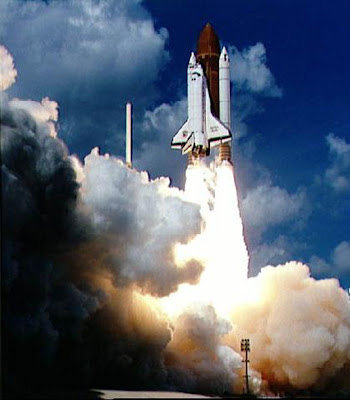
Liftoff of STS-34 Atlantis, carrying the Galileo spacecraft
  • Launch: Oct. 18, 1989, from Kennedy Space Center, Fla., on space shuttle Atlantis on mission STS-34
  • Arrival in orbit around Jupiter: Dec. 7, 1995
  • VEEGA (Venus-Earth-Earth Gravity Assist) is the acronym mission planners gave for Galileo's flight path through the inner solar system
  • Observed impacts of fragments from comet Shoemaker-Levy 9 into Jupiter
  • Approximate number of people (from around the world) who worked on the Galileo mission: 800
  • More than 100 scientists from United States, Great Britain, Germany, France, Canada and Sweden carried out Galileo's experiments
PASADENA, Calif. - NASA's Galileo spacecraft began what would become a 14-year odyssey of exploration 20 years ago this Sunday, Oct. 18. Galileo was humanity's first emissary to orbit a planet in the outer solar system - Jupiter.

Galileo was launched into space aboard the space shuttle Atlantis on Oct. 18, 1989, from Kennedy Space Center, Florida. The crew of Atlantis deployed Galileo out of the shuttle's cargo bay only hours after launch. Then, a little over seven hours after leaving Earth, Galileo was propelled onto its interplanetary flight path by a two-stage, solid-fuel motor called an Inertial Upper Stage. Although earlier plans called for Galileo to use a more powerful upper stage so that it could fly directly to Jupiter, the final flight took it by other planets first so that it could gain energy from the gravity of each. Galileo flew past Venus on Feb. 10, 1990, and then twice past Earth -- once on Dec. 8, 1990, and again on Dec. 8, 1992.

Even before its arrival at Jupiter in 1995, Galileo was making groundbreaking discoveries. On Oct. 29, 1991, the spacecraft flew past asteroid Gaspra - sending back the first close up images of one of these celestial wanderers. Then on Aug. 28, 1993, Galileo encountered the 15.2-kilometer-wide (9.4-mile) asteroid Ida, where it took the first images of an asteroid and discovered the first asteroid moon, the 1.6-kilometer-wide (1-mile) Dactyl. During the latter part of its interplanetary cruise, Galileo was used to observe the collisions of fragments of Comet Shoemaker-Levy with Jupiter in July 1994.

Galileo arrived at Jupiter on Dec. 7, 1995, entering orbit and dropping a probe into the giant planet's atmosphere. The probe's velocity as it entered Jupiter's atmosphere was a blistering 47.6 kilometers per second (106,500 miles per hour). After the atmospheric drag and a deployed parachute slowed its descent rate, the probe relayed to Galileo the first in-place studies of Jupiter's clouds and winds, furthering scientists' understanding of how the gas giant evolved. The probe also made composition measurements designed to assess the degree of evolution of Jupiter compared to the sun.

While the descent of the probe was a highlight of Galileo's mission, it was hardly the only one. Galileo extensively investigated the geologic diversity of Jupiter's four largest moons: Ganymede, Callisto, Io and Europa. It found that Io's extensive volcanic activity is 100 times greater than that found on Earth. Galileo discovered strong evidence that Jupiter's moon Europa has a melted saltwater ocean under an ice layer on its surface. Scientists estimate such an ocean could be up to 100 kilometers (62 miles) deep underneath its frozen surface and contain about twice as much water as all of Earth's oceans. Data showed moons Ganymede and Callisto may also have a liquid-saltwater layer. The biggest discovery surrounding Ganymede was the presence of a magnetic field. No other moon of any planet is known to have one.

When Galileo turned its instruments towards the giant gas world itself, the spacecraft made the first observations of ammonia clouds in another planet's atmosphere. It also observed numerous thunderstorms on Jupiter many times larger than those on Earth, with lightning strikes up to 1,000 times more powerful than on Earth. It was the first spacecraft to dwell in a giant planet's magnetosphere long enough to identify its global structure and to investigate the dynamics of Jupiter's magnetic field. Galileo determined that Jupiter's ring system is formed by dust kicked up as interplanetary meteoroids smash into the planet's four small inner moons. Galileo data showed that Jupiter's outermost ring is actually two rings, one embedded within the other.

Having traveled approximately 4.6 billion kilometers (about 2.8 billion miles), the hardy spacecraft endured more than four times the cumulative dose of harmful Jovian radiation it was designed to withstand -- and still major systems functioned. But while it was still enjoying relatively good health, the spacecraft's propellant was low. Without propellant, Galileo would not be able to point its antenna toward Earth or adjust its trajectory, so controlling the spacecraft would no longer be possible. Mission managers at NASA and JPL decided to place their resilient Jovian explorer on a collision course with Jupiter to eliminate any chance of an unwanted impact between the spacecraft and Europa. The possibility of life existing on Europa is so compelling and has raised so many unanswered questions that it is prompting plans for future spacecraft to return to the icy moon.

The Galileo spacecraft's 14-year odyssey came to an end on Sunday, Sept. 21, 2003, when the spacecraft passed into Jupiter's shadow, then disintegrated in the planet's dense atmosphere at 11:57 a.m. Pacific Daylight Time. Its entry speed was 48.2 kilometers per second (nearly 108,000 miles per hour). That is the equivalent of traveling from Los Angeles to New York City in 82 seconds.

JPL's Deep Space Network tracking station in Goldstone, Calif., received the last signal at 12:43:14 PDT, 46 minutes after it was sent. The delay is due to the time it takes for the signal to travel to Earth. Hundreds of former Galileo project members and their families were present at JPL for a celebration to bid the spacecraft goodbye.

Galileo project scientist Torrence Johnson said at the time, "We haven't lost a spacecraft, we've gained a steppingstone into the future of space exploration."

JPL, a division of the California Institute of Technology in Pasadena, managed the Galileo mission for NASA. JPL designed and built the Galileo orbiter, and operated the mission.

Updated Arrival Time for STS-129 Astronauts

Shuttle Atlantis secured at Launch Pad 39A
The six STS-129 mission astronauts are on their way to NASA's Kennedy Space Center in Florida to participate in a launch dress rehearsal and related training known as the Terminal Countdown Demonstration Test, or TCDT.

Five of the crew members are flying in their T-38 training jets. Currently, they’ve stopped for refueling in Mississippi and are expected to arrive after 11 a.m. EDT at Kennedy’s Shuttle Landing Facility.

Mission Specialist Leland Melvin will be further delayed because the G2 NASA aircraft he was flying had a technical issue and returned to Ellington Field near NASA's Johnson Space Center in Houston.

Because of the delayed arrival times, TCDT crew arrival will not be carried live on NASA Television but it will air as a Video File segment on NASA TV this afternoon on www.nasa.gov/ntv.

STS-129 Crew at Kennedy for TCDT

The STS-129 mission astronauts are flying to NASA's Kennedy Space Center in Florida today in their T-38 jets.

The crew will be at Kennedy Oct. 19, 20, 21, to train for their upcoming flight to the International Space Station on space shuttle Atlantis.

The training, known as the Terminal Countdown Demonstration Test, or TCDT, gives the crew an opportunity to check the fit of their spacesuits, practice emergency evacuation procedures at the launch pad, review firefighting methods and participate in a simulated launch countdown and other activities.

Today's training includes driving M-113 armored personnel carriers. Commander Charles O. Hobaugh and Pilot Barry E. Wilmore will take to the skies in NASA's Shuttle Training Aircraft to practice shuttle landings at Kennedy's Shuttle Landing Facility.

NASA Reschedules Rollout Of Ares I-X

NASA has rescheduled to Tuesday, Oct. 20, the rollout of the Ares I-X rocket to Launch Pad 39B at the Kennedy Space Center in Florida.

The first motion of the Ares I-X out of Kennedy's Vehicle Assembly Building is targeted for 12:01 a.m. EDT. The 4.2-mile journey is expected to last about seven hours. Media activities include a first motion photo opportunity and interviews with Ares I-X managers. In addition, a sunrise photo opportunity will be available at 7 a.m.

Live NASA Television coverage with commentary will start at 11:45 p.m., Oct. 19, and 7 a.m., Oct. 20. Video highlights of the move will air on NASA Television's Video File.

Reporters must arrive at Kennedy's news center by 10:30 p.m., Oct. 19 for transportation to the viewing area. For the sunrise event, reporters must arrive by 6:30 a.m., Oct. 20. Media accreditation for these events is closed.

Badges will be available for pick up at the badging facility on State Road 3 on Monday, Oct. 19, from 8:30 - 10 p.m. Updates with times for all events are available by calling 321-867-2525. All participants must be properly dressed in full-length pants, flat shoes that entirely cover the feet, and shirts with sleeves.

The rollout of Ares I-X originally was set for Monday, Oct. 19. During testing on Oct. 14, engineers detected a nitrogen gas leak in an accumulator located in the aft skirt of the rocket. The accumulator, which absorbs hydraulic pressure spikes as the system operates, was replaced and successfully retested. Management is assessing what effect, if any, this delayed rollout will have on the targeted Oct. 27 launch date.

Ready to Roll


In the Kennedy Space Center's Orbiter Processing Facility-1 in Florida, workers prepared space shuttle Atlantis to move from its hangar to the transfer aisle inside the nearby Vehicle Assembly Building.

Subsequently, the shuttle was rolled to the launch pad in anticipation of its Nov. 12, 2009, launch on the STS-129 mission to the International Space Station.

NASA and the National Federation of the Blind Celebrate Release of the 2009 Louis Braille Bicentennial Silver Dollar


To commemorate the United States Mint's release of the 2009 Louis Braille Bicentennial Silver Dollar and to recognize the critical role that Braille plays in the pursuit of careers in math and science by the blind, NASA's STS-125 mission flew two of the coins aboard during the Hubble Servicing Mission. This commemorative coin, only available until Dec. 11, 2009, is the first U.S. coin to have readable Braille on it and is a testament to the importance of Braille in the lives of the blind people.

Associate Administrator Chris Scolese presented them to Mark Riccobono, executive director of the Jernigan Institute of the National Federation of the Blind during the closing ceremony of the NFB Youth Slam--the largest gathering of blind students and mentors brought together to inspire and engage blind youth in science, technology, engineering and math.

In celebration of the 200th anniversary of Louis Braille's birthday, Congress authorized the minting of the 2009 Louis Braille Bicentennial Silver Dollar. The coins are the first to feature tactile, readable Braille, which enables the blind to read and learn, just as Hubble allows people to learn about the universe.

As authorized by Congress, the United States Braille coin will fund efforts by the National Federation of the Blind to reverse the Braille literacy crisis in America. After Dec. 11, any unsold coins are melted down.

Dr. Marc Maurer, President of the National Federation of the Blind, said: "This is an exciting moment because the general public has the chance to buy a piece of history -- a coin that not only represents knowledge and empowerment for blind people but that also [visited] the Hubble Space Telescope."

NASA astronaut Gregory H. Johnson will speak at the celebratory closing of the National Federation of the Blind's 2009 Youth Slam. At the Youth Slam, 200 blind high school students from across the nation will participate in five days of activities to help encourage the blind youth of America to consider careers in science, technology, engineering and mathematics.

NASA and the National Federation of the Blind have been collaborating for more than five years to inspire and engage blind students to lend their unique talents to disciplines critical to the nation's engineering, scientific and technical missions.

Andromeda in Ultraviolet

Andromeda Galaxy
In a break from its usual task of searching for distant cosmic explosions, NASA's Swift satellite acquired the highest-resolution view of a neighboring spiral galaxy ever attained in the ultraviolet. The galaxy, known as M31 in the constellation Andromeda, is the largest and closest spiral galaxy to our own. This mosaic of M31 merges 330 individual images taken by Swift's Ultraviolet/Optical Telescope. The image shows a region 200,000 light-years wide and 100,000 light-years high (100 arcminutes by 50 arcminutes).

The Rite of Spring

Saturn
Of the countless equinoxes Saturn has seen since the birth of the solar system, this one, captured in a mosaic of light and dark, is the first witnessed up close by an emissary from Earth … none other than our faithful robotic explorer, Cassini.

Seen from our planet, the view of Saturn's rings during equinox is extremely foreshortened and limited. But in orbit around Saturn, Cassini had no such problems. From 20 degrees above the ring plane, Cassini's wide angle camera shot 75 exposures in succession for this mosaic showing Saturn, its rings and a few of its moons a day and a half after exact Saturn equinox, when the sun/s disk was exactly overhead at the planet's equator. The novel illumination geometry that accompanies equinox lowers the sun's angle to the ring plane, significantly darkens the rings, and causes out-of-plane structures to look anomalously bright and to cast shadows across the rings. These scenes are possible only during the few months before and after Saturn’s equinox which occurs only once in about 15 Earth years. Also at equinox, the shadows of the planet's expansive rings are compressed into a single, narrow band cast onto the planet as seen in this mosaic.

The images comprising the mosaic, taken over about eight hours, were extensively processed before being joined together. With no enhancement, the rings would be essentially invisible in this mosaic. To improve their visibility, the dark right half of the rings has been brightened relative to the brighter left half by a factor of three, and then the whole ring system has been brightened by a factor of 20 relative to the planet. So the dark half of the rings is 60 times brighter, and the bright half 20 times brighter, than they would have appeared if the entire system, planet included, could have been captured in a single image.

The images were taken on Aug. 12, 2009, beginning about 1.25 days after exact equinox, using the red, green and blue spectral filters of the wide angle camera and were combined to create this natural color view. The images were obtained at a distance of approximately 526,000 miles from Saturn and at a Sun-Saturn-spacecraft, or phase, angle of 74 degrees. Image scale is 31 miles per pixel.

Atlantis is Secured at the Pad

Shuttle Atlantis secured at Launch Pad 39A
At NASA’s Kennedy Space Center in Florida, space shuttle Atlantis is firmly secured to the fixed service structure pedestals at Launch Pad 39A. The 3.4-mile journey from the Vehicle Assembly Building to the launch pad began at 6:38 a.m. EDT and was completed at 1:31 p.m.

The pad's protective rotating service structure will be closed around the shuttle tonight, and launch pad teams will begin preparations to support Atlantis' targeted Nov. 12 launch at 4:04 p.m. EST.

The STS-129 astronauts are scheduled to fly to Kennedy on Oct. 19 to participate in the three-day Terminal Countdown Demonstration Test, or TCDT. This training gives the crew an opportunity to check the fit of their spacesuits, practice emergency evacuation procedures at the launch pad, review firefighting methods and participate in a simulated launch countdown.

NASA Celebrates Earth Science Week

Every day at NASA scientists study changes on our home planet, and a significant portion of that study focuses on changes in our oceans. To showcase some of that research, NASA is releasing six short videos in commemoration of Earth Science Week 2009. The videos highlight the connection between climate change and our oceans.

The theme of Earth Science Week (October 11 through 17) this year is "Understanding Climate." The six NASA videos complete a series called "Tides of Change," which all focus on the ocean-climate connection. Each video features a specific component of the connection, such as marine life or the water cycle.

Another highlight of NASA's Earth Science Week contributions is a live educational webcast on October 14 at 1 p.m., EDT. Classrooms around the country will participate in this live event that focuses on Earth science discoveries and careers. Two oceanographers will discuss their careers, illustrate NASA’s unique, space-based view of the oceans and answer participant questions. Watch the webcast here.

Also part of NASA's offerings, the agency's Global Climate Change Web site will feature these videos and a 3D interactive, "Eyes on Earth." The downloadable Eyes on Earth application allows users to observe the paths of satellites that study our planet, learn about related missions and more.

Earth Science Week, organized by the American Geological Institute, encourages people everywhere to explore our planet and learn about geoscience fields.

Though Earth Science Week 2009 only lasts through October 17, At NASA every week is Earth science week, as scientists continue to learn about our changing planet and what drives those changes. A world of Earth science exploration is all at your fingertips and on-line from NASA's Earth Web site any day of the week.

Aviation Pioneer Richard T. Whitcomb

Richard T. Whitcomb
Aviation pioneer Richard Whitcomb has died in Newport News at the age of 89. The NASA Langley Research Center engineer has been called the most significant aerodynamic contributor of the second half of the 20th century.

If you look at almost any large airplane today -- especially those that fly at supersonic speeds -- you can see the genius of Dick Whitcomb.

"Dick Whitcomb's intellectual fingerprints are on virtually every commercial aircraft flying today," said Tom Crouch, noted aviation historian at the Smithsonian Institution. "It's fair to say he was the most important aerodynamic contributor in the second half of the century of flight."

Born in Illinois in 1921, Richard Travis Whitcomb was the son and grandson of engineers. He grew up in Worcester, Mass., building model airplanes, in an era when aviation pioneers such as Charles Lindbergh were household names.

His interest in aeronautics continued into college at Worcester Polytechnic Institute, where he joined the aeronautics club and spent a lot of time in the school's wind tunnel.

Whitcomb came to what is now NASA's Langley Research Center in Hampton, Va., in 1943, during World War II, right after graduating with a Bachelor of Science in mechanical engineering and highest honors.

It was a busy time for aeronautical engineers working to improve America's military air superiority and Whitcomb dived right in. In less than a decade he tackled and solved one of the biggest challenges of the day -- how to achieve practical, efficient transonic and supersonic flight.

In interviews over the years Whitcomb told how he was sitting one day with his feet up on his desk when he had a "Eureka!" moment and came up with what is known as the Whitcomb area rule. He theorized the shape of the fuselage could be changed to reduce the aircraft shock wave drag that occurs near the speed of sound. The basic idea was to ensure a smooth cross sectional area distribution between the front and back of the plane. "We built airplane models with Coke bottle-shaped fuselages and lo and behold the drag of the wing just disappeared," said Whitcomb. "The wind tunnel showed it worked perfectly."

For that innovation the Langley engineer won the 1954 Collier Trophy for the year's greatest achievement in aviation in the U.S.

Whitcomb came up with three important aeronautical innovations while working at NASA Langley, one in each decade of his career. If the area rule was Whitcomb's major accomplishment of the 1950s, his supercritical wing revolutionized the design of jet liners after the 1960s. The key was the development of an airfoil that was flatter on the top and rounder on the bottom with a downward curve on the trailing edge. That shape delayed the onset of drag, increasing the fuel efficiency of aircraft flying close to the speed of sound.

In the 1970s it was an article on birds that led Whitcomb to develop his third significant innovation -- winglets -- refining an idea that had been around for decades. Other engineers had suspected that end plates added to the wing tips could reduce drag. But the Langley engineer proved a simple vertical plate wasn't enough. "It is a little wing. That's why I called them winglets," said Whitcomb. "It's designed with all the care that a wing was designed." Winglets reduce yet another type of drag and further improve aerodynamic efficiency. Many airliners and private jets sport wingtips that are angled up for better fuel performance.

Those who worked with Whitcomb remember him as brilliant, driven and single-minded with aerodynamics dominating his thoughts at work and at home. "I was extremely fortunate to work with Dick Whitcomb from 1974 to 1980, when I was an engineer fresh out of college," said Pete Jacobs, chief engineer for the Ground Facilities and Testing Directorate at NASA Langley. "It was truly an amazing experience to learn from the man who had been referenced in my textbooks. He had an uncanny sense of aerodynamics, unbelievable concentration, and the most phenomenal memory of anyone I've ever met."

The famed aerodynamicist retired from NASA Langley in 1980, but his contributions remain some of the research center's greatest accomplishments. "Dick Whitcomb's three biggest innovations have been judged to be some 30 percent of the most significant innovations produced by NASA Langley through its entire history," said Langley chief scientist Dennis Bushnell, who worked with Whitcomb. "That's from its founding in 1917 to the present. He is without the doubt the most distinguished alumnus of the Langley Research Center."

Whitcomb earned many honors in his life. Besides the Collier Trophy, he received the National Medal of Science (personally conferred by President Richard Nixon) in 1973, the U.S. Air Force Exceptional Service medal in 1955, the first NACA Distinguished Service Medal in 1956, the NASA Exceptional Scientific Achievement Medal in 1959 and the National Aeronautics Association's Wright Brothers Memorial Trophy in 1974. The engineer was also was inducted into the National Inventors' Hall of Fame in 2003, the National Academy of Engineering in 1976 for his pioneering research in the aerodynamic design of high performance aircraft and the Paul E. Garber First Flight Shrine at the Wright Brothers National Memorial. Whitcomb's alma mater, Worcester Polytechnic Institute, also awarded him an honorary doctorate and its presidential medal.

Whitcomb requested there be no funeral. Instead his ashes will be spread by plane over the Chesapeake Bay.

Inside Job

Inside the AresI-X rocket
In the Vehicle Assembly Building's High Bay 3 at NASA's Kennedy Space Center in Florida, a technician works on a platform mounted on the interior wall of the upper stage simulator of the 327-foot-tall Ares I-X rocket.

Liquid Methane Tank

Liquid Methane Tank
It's not a new home brewing system, the world's largest holiday ornament or even an ambitious Death Star model. This spherical propellant tank is an important component of testing for the Altair lunar lander, an integral part of NASA's Constellation Program. This 4-foot diameter propellant tank lives at NASA's Glenn Research Center's Small Multipurpose Research Facility (SMiRF). It will be covered in 60 layers of high performance insulation, filled with liquid methane and extensively tested in a simulated lunar thermal environment within the SMiRF vacuum chamber. Determining how liquid methane would react to being stored on the moon could dramatically influence lunar travel; this method holds the potential to be less expensive, higher performing and safer than current rocket propellants.

NASA Television to Broadcast Cargo Ship Arrival at Space Station

The residents of the International Space Station will receive a new shipment of food, fuel and supplies at 8:41 p.m. CDT on Saturday, Oct. 17. NASA Television's coverage of the ship's arrival at the station will begin at 8:15 p.m.

The Russian ISS Progress 35 cargo ship, filled with more than two tons of supplies for the station, is set to launch from the Baikonur Cosmodrome in Kazakhstan on Wednesday, Oct. 14 at 8:14 p.m. There will be no television coverage of the launch.

Expedition 21 Commander Frank De Winne and Flight Engineers Jeff Williams, Nicole Stott, Roman Romanenko, Max Suraev and Bob Thirsk will observe the event from aboard the station as the unpiloted craft automatically docks to the station's Pirs Docking Compartment.

For NASA Television streaming video, downlink and schedule information, visit:

http://www.nasa.gov/ntv

Preparations for STS-129 Mission in Full Swing

The STS-129 mission will be commanded by Charles O. Hobaugh and piloted by Barry E. Wilmore. Mission Specialists are Robert L. Satcher Jr., Mike Foreman, Randy Bresnik and Leland Melvin. Wilmore, Satcher and Bresnik will be making their first trips to space.

Atlantis and its crew will deliver two control moment gyroscopes, equipment and EXPRESS Logistics Carrier 1 and 2 to the International Space Station. The mission will feature three spacewalks.

Atlantis also will return station crew member Nicole Stott to Earth and is slated to be the final space shuttle crew rotation flight.

Launch of Atlantis on the STS-129 mission is targeted for 4:04 p.m. EST Nov. 12.

Atlantis is on the Move

Atlantis is rolled to Launch Pad 39A
Space shuttle Atlantis began its move from the Vehicle Assembly Building to Launch Pad 39A at NASA's Kennedy Space Center in Florida at 6:38 a.m. EDT. The 3.4-mile journey of the crawler-transporter with the shuttle stacked on top is expected to take about six hours.

At NASA's Johnson Space Center in Houston, the STS-129 astronauts are rehearsing orbit maneuvers today in the fixed base simulator.

The simulator mimics the dials and controls of the shuttle along with monitors that animate a view from outside the shuttle's window. Johnson technicians program the simulator's software to throw various problem situations at the crew to make sure they can cope with anything while in flight.

Meanwhile, the Space Shuttle Program's Flight Readiness Review, or FRR, is scheduled for Oct. 20 and 21. The executive-level FRR with NASA managers to set an official launch date is planned for Oct. 29 and will be held at Kennedy.

Atlantis' Move to Launch Pad Under way

Space shuttle Atlantis' move to Launch Pad 39A at NASA's Kennedy Space Center in Florida is under way. First motion of Atlantis out of Kennedy's Vehicle Assembly Building was at 6:38 a.m. EDT. The 3.4 mile trip, known as rollout, is expected to take about six hours.

Atlantis and its six astronauts are targeted to launch Nov. 12 on the STS-129 mission to the International Space Station.

Expedition 20 Lands

Expedition 20 landing
The Soyuz TMA-14 spacecraft is seen as it lands with Expedition 20 Commander Gennady Padalka, Flight Engineer Michael Barratt, and spaceflight participant Guy Laliberte near the town of Arkalyk, Kazakhstan on Sunday, Oct. 11, 2009. Padalka and Barratt returned from six months onboard the International Space Station, along with Laliberte who arrived at the station on Oct. 2 with Expedition 21 Flight Engineers Jeff Williams and Maxim Suraev aboard the Soyuz TMA-16 spacecraft.

The X-1 Research Airplane

XS-1 in flight

Beginning in 1946, two XS-1 experimental research aircraft (later redesignated X-1s) conducted pioneering tests at Muroc Army Air Field (now Edwards Air Force Base) in California to obtain flight data on conditions in the transonic speed range. These early tests culminated on October 14, 1947, in the first piloted flight faster than Mach 1.0, the speed of sound.

The XS-1 was the first high-speed aircraft built purely for aviation research purposes. The model was never intended for production. The XS-1 was designed largely in accordance with specifications provided by the National Advisory Committee for Aeronautics (NACA) [now National Aeronautics and Space Administration], paid for by the Army Air Forces, and built by Bell Aircraft Inc. The XS-1 #2 (serial number 46-063) was flight tested by the NACA to provide design data for later production high-performance aircraft.

The research techniques used in the X-1 program became the pattern for all subsequent X-craft projects. The NACA X-1 procedures and personnel also helped lay the foundation of America's space program in the 1960s. The X-1 project defined and solidified the post-war cooperative union between U.S. military needs, industrial capabilities, and research facilities. The flight data collected by the NACA in the X-1 tests then provided a basis for American aviation supremacy in the latter half of the 20th century.

As a result of the X-1's initial supersonic flight, the National Aviation Association voted its 1948 Collier Trophy to be shared by the three main participants in the program. Honored at the White House by President Truman were Lawrence "Larry" Bell for Bell Aircraft, Captain Charles E. "Chuck" Yeager for piloting the flights, and John Stack of NACA for the NACA contributions.

The sharing of this award exemplified the partnership among the three participants that had led to this significant aviation milestone. Further testifying to the partnership between the NACA and the Air Force (as the Army Air Forces [AAF] became in September 1947) in the latter part of the program was a statement by Major General Albert Boyd, who had headed Wright Field's Flight Test Division and then the Air Force's flight test unit at Edwards.

Expedition 20 Comes Home


Surrounded by medical personnel, seated from left to right are spaceflight participant Guy Laliberte, Expedition 20 Commander Gennady Padalka and Expedition 20 Flight Engineer Michael Barratt.They had landed minutes before at 12:32 a.m. EDT aboard the Soyuz capsule near the town of Arkalyk, Kazakhstan, on Sunday, Oct. 11, 2009. Padalka and Barratt are returning from six months onboard the International Space Station, along with Laliberte who arrived at the station on Oct. 2 with Expedition 21 Flight Engineers Jeff Williams and Maxim Suraev aboard the Soyuz TMA-16 spacecraft.

Diviner Observes LCROSS Impact

The LRO Diviner instrument obtained infrared observations of the LCROSS impact. LRO flew by the LCROSS Centaur impact site 90 seconds after impact at a distance of ~80 km. Diviner was commanded to observe the impact site on eight successive orbits, and obtained a series of thermal maps before and after the impact at approximately two hour intervals at an angle of approximately 48 degrees off nadir. In this viewing geometry, the spatial footprint of each Diviner detector was roughly 300 by 700 meters.

Diviner thermal map of the LCROSS impact sites
Figure 1 shows the locations of the Diviner LCROSS impact swaths overlain on a grayscale daytime thermal map of the Moon’s south polar region. Diviner data were used to help select the final LCROSS impact site inside Cabeus Crater, which sampled an extremely cold region in permanent shadow that can serve as an effective cold trap for water ice and other frozen volatiles. Credit NASA/GSFC/UCLA


Figure 2 shows preliminary, uncalibrated Diviner thermal maps of the impact site acquired two hours before the impact, and 90 seconds after the impact. The thermal signature of the impact was clearly detected in all four Diviner thermal mapping channels. Since the LCROSS impact feature is predicted to be significantly smaller than a Diviner footprint, its detection is consistent with the notion that the LCROSS impact resulted in significant local heating of the lunar surface. Credit NASA/GSFC/UCLA

Expedition 20 Crew, Spaceflight Participant Land in Kazakhstan

Expedition 20 Commander Gennady Padalka, Flight Engineer Michael Barratt and Canadian spaceflight participant Guy Laliberte have returned to Earth, landing on the steppe of Kazakhstan in their Soyuz TMA-14 spacecraft. Landing occurred at 12:32 a.m. EDT, 10:32 a.m. Kazakhstan time.

Padalka and Barratt stayed aboard the orbiting laboratory for 197 days. The duo arrived at the station in March to begin Expedition 19 then transitioned to the six-member Expedition 20 crew in May. Padalka commanded both Expedition crews. Laliberte launched Sept. 30 with the Expedition 21 crew and spent nine days on the station.

The three were scheduled to fly back to the Gagarin Cosmonaut Training Center in Star City, Russia outside Moscow early Sunday for reunions with their families, and for Padalka and Barratt, the start of their reorientation to a gravity environment after a half year off the planet.

Soyuz Landing Caps Historic Space Station Increment

International Space Station Expedition 20 Commander Gennady Padalka and Flight Engineer Michael Barratt landed their Soyuz TMA-14 spacecraft on the steppes of Kazakhstan Sunday, wrapping up a six-month stay. Joining them was spaceflight participant Guy Laliberte, who spent 11 days in space.

Padalka, the Soyuz commander, guided the spacecraft to a parachute-assisted landing at 12:32 a.m. EDT at a site northeast of the town of Arkalyk.

Russian recovery teams were on hand within minutes of landing to help the crew exit from the Soyuz vehicle and reacclimate to gravity. The crew members will return to the Gagarin Cosmonaut Training Center in Star City, outside of Moscow, for reunions with their families.

Padalka and Barratt spent 199 days in space and 197 days on the station after their March 26 launch. Laliberte launched with the Expedition 21 crew on a Soyuz vehicle Sept. 30 and returned after nine days on the station.

Padalka and Barratt presided over the inauguration of a six-person crew and two space shuttle assembly and resupply missions to the station. They also were station crew members during the delivery of tons of cargo and new science facilities for expanded research, and the arrival of the first Japanese H-II Transfer cargo vehicle.

The station now is occupied by Expedition 21 Commander Frank De Winne of the European Space Agency and Flight Engineers Roman Romanenko and Max Suraev of Russia, Bob Thirsk of the Canadian Space Agency and Nicole Stott and Jeff Williams of NASA.

Henri Now Disorganized, Forecasters Watching a Low Near Venezuela

The remnant clouds and thunderstorms that once belonged to Tropical Storm Henri show up on NASA satellite imagery as a disorganized area of cloudiness. South of where Henri's remnants are located, however, is an interesting area of disturbed weather approaching Venezuela.

NASA's Aqua satellite flew over the area of clouds and showers during the afternoon of October 8 and visible imagery revealed that the remnants Henri were disorganized. At that time Henri had weak low-level circulation, and any convection (rising air that forms thunderstorms) was removed from the center of the storm. When thunderstorms and showers become detached from a storm's low-level center it's an indication that the storm is waning. Henri's dying breath came around 5 p.m. EDT last night, October 8, when his sustained winds were last near 30 mph and they've weakened significantly since then.

By the morning of October 9, Henri's remnants were located about 200 miles northeast of San Juan, Puerto Rico. The remnants were producing disorganized thunderstorms. The northern Leeward Islands and Virgin Islands should anticipate 1-2 inches of rain.

The National Hurricane Center noted that Henri was done in by vertical wind shear and because the system is still in an unfavorable environment (still battling wind shear), regeneration is not expected.

Meanwhile, NASA's Aqua satellite also caught a glimpse of an area of disturbed weather associated with a tropical wave near the Windward Islands. That area of cloudiness has more form to it than Henri's remnants and its moving at a good clip, between 20-25 mph. The system did become less organized since late Thursday, and development into a tropical cyclone isn't expected in the next day or two as it interacts with Northern Venezuela over the weekend. Still, the National Hurricane Center gives it less than a 30 percent chance of development. It will be an area of interest over the weekend.

High in Chilean Desert, NASA’s FIRST Makes New Observations of Earth’s Atmosphere

When a team from NASA's Langley Research Center wanted to study water vapor in the atmosphere, they decided to go to one of the driest places on Earth. From a mobile lab on a mountain-top in Chile's Atacama Desert, the Langley-led team has spent months observing water vapor's effect on the climate. The remote and dry location allows for better scientific observations.

Using a new instrument called Far-Infrared Spectroscopy of the Troposphere (FIRST), the team is taking measurements of water vapor emissions in the "far infrared." This part of the spectrum has rarely been measured from the ground, and has never been measured thoroughly from space, though it is thought to account for half of the Earth's cooling emissions to space. The FIRST campaign in Chile, from August to October, will help Langley scientists and engineers better understand how water vapor controls the climate and energy balance of the planet. FIRST is also a prototype for an instrument that would eventually fly on the Climate Absolute Radiance and Refractivity Observatory (CLARREO) mission, which would be the first to measure the full infrared spectrum from space.

Closer Moon View

View of moon from LCROSS spacecraft
A closer view of the moon as the LCROSS spacecraft approaches impact.

Some Assembly Required

Space shuttle Atlantis
Space shuttle Atlantis is lowered toward a mobile launcher platform in High Bay 1 in the Vehicle Assembly Building at NASA's Kennedy Space Center in Florida. Next, Atlantis will be attached to the external fuel tank and pair of solid rocket boosters secured to the platform.

Going Up

Space shuttle Atlantis
A yellow crane lifts space shuttle Atlantis high above the transfer aisle and toward the transom of High Bay 1 in the Vehicle Assembly Building at NASA's Kennedy Space Center in Florida. Once in High Bay 1, the orbiter is attached to its external fuel tank and solid rocket boosters.

Post Impact Press Conference

The LCROSS Centaur and Spacecraft impacted the moon at approximately 4:30 a.m. PDT. Scientists are reviewing the initial data and will report what they know at a Post Impact News Conference at 7:00 a.m. PDT / 10:00 a.m. EDT on NASA TV.

Data Assessment

The LCROSS science team is making their preliminary assessment of approximately four minutes of data collected from the LCROSS Spacecraft. Observatories involved in the LCROSS Observation Campaign are reporting in.

LCROSS Coverage

Live coverage of LCROSS Impact Event starts at 3:15 a.m. PDT or 6:15 a.m. EDT on NASA TV http://www.nasa.gov/ntv

Breaking Maneuver

Mission operations is initiating the breaking maneuver. This will create the 4 minute, 373 mile (600 km) separation planned for optimal data of the Centaur Impact Flash and debris plume. The breaking burn is 4 min 5 sec. in duration.

Successful Centaur Separation Mission Update

At 6:50 p.m. on Thursday, Oct. 8 the LCROSS shepherding spacecraft successfully separated from the Centaur that is has been attached to since early June 2009, when the LCROSS and LRO were stacked at Space Launch Complex 41, a few days before launch from Cape Canaveral. After the separation sequence was initiated, sensors attached to three break wires indicated a successful separation.

After the separation, the LCROSS shepherding spacecraft completed a 180 degree flip maneuver and powered up the science payload to watch the Centaur steadily increase the distance between them. Mission operations then commanded the spacecraft to perform a breaking burn to create a separation distance of 600 km from the Centaur, This was determined by the science team as the optimal distance to view the Centaur on the surface of the moon.

The Centaur will impact the floor of Cabeus crater at 4:31:19 a.m. PDT. Following about 4 minutes behind and collecting and transmitting data back to LCROSS mission control, the Shepherding spacecraft will impact the surface at approximately 4:35:45 a.m. PDT.

Centaur Separation

The mission operations team has initiated the Centaur separation sequence. The tripping of 3 breakwire sensors will be the most immediate indication of a successful separation. After verification by the mission operations team, the spacecraft will perform a 180 degree pitch maneuver (turning around) to reorient the LCROSS sciene payload towards the receding Centaur. This is the first maneuver performed by the LCROSS spacecraft in a detached configuration. The maneuver takes approximately three minutes.

Targeting Accuracy Requirement

The LCROSS mission has a targeting accuracy requirement of a 12.4 mile (20km) circle, however the team has managed to greatly improve that accuracy to better than a 2.17 mile (3.5 km) circle.

LCROSS is on the correct trajectory

The mission operations team has waived off Trajectory Correction Maneuver (TCM) 10. Spacecraft telemetry indicates that the spacecraft is on the correct trajectory to impact the designated location within Cabeus.

Centaur Separation

Impacts into Cabeus in approximately 12 hours. Impact of the Centaur is currently scheduled for 4:31:19 a.m. PDT followed closely by the impact of the LCROSS Shepherding Spacecraft at 4:35:45 a.m. PDT. These times may change slightly after the LCROSS Navigation team has reviewed the separation and breaking burn data. The final times will be known around 2 a.m. PDT Oct 9th and will be posted here. At impact minus 12 hrs, LCROSS is approximately 29,879 miles (48,086 km) from the moon traveling at 2,691 miles per hour (MPH) or 1.20 kilometers per second (km/s).

LCROSS Live Broadcast

A live NASA TV Broadcast is planned for the LCROSS impacts starting at 6:15 a.m. EDT/3:15 a.m. PDT, Oct. 9, on NASA TV and www.nasa.gov/ntv.

The 1.5 hour broadcast includes:
  • Live footage from spacecraft camera
  • Real-time telemetry based animation
  • Views of LCROSS Mission and Science Operations
  • Broadcast commentary with expert guests
  • Prepared video segments
  • Views of the public impact viewing event at NASA Ames
  • Possible live footage from the University of Hawaii, 88-inch telescope on Mauna Kea.
The live LCROSS Post-Impact News Conference will be 10 a.m. EDT/7 a.m. PDT on NASA TV and www.nasa.gov/ntv.

Hurricane Season 2009: Tropical Storm Henri in Atlantic Ocean found by NASA

AIRS image of Tropical Storm Henri
Forecasters were watching a storm they designated as 91 yesterday, October 6, until it organized into a tropical cyclone east of the Leeward Islands around 5 p.m. EDT. It was then named "Tropical Storm Henri," the eighth named tropical cyclone of the Atlantic hurricane season.

On Wednesday, October 7 at 11 a.m. EDT, Henri had maximum sustained winds near 45 mph after reaching a peak sustained wind speed of 50 mph at 5 a.m. EDT today. Henri's center was located about 375 miles east of the Northern Leeward Islands, near 18.9 North and 57.4 West. Estimated minimum central pressure is 1007 millibars.

Henri is moving west-northwest near 15 mph and should continue in that direction for the next day before turning west. A subtropical ridge (an area of high pressure) over the Western Atlantic Ocean will be steering Henri over the next day or two. That area of high pressure will press Henri in a west or west-northwesterly direction. Over time, the ridge will become stronger, forcing Henri in a more westerly direction.

NASA's Aqua satellite AIRS instrument captured an infrared image of Henri's clouds on October 7 at 1:29 a.m. EDT. Henri already had some strong convective activity in his center as indicated by high thunderstorms (in purple) that were as cold as -63F.

The National Hurricane Center noted this morning, "Satellite imagery showed that the center of Henri has become exposed to the west of a mass of deep convection." In addition to the center being exposed, further weakening is likely due to increasing southwesterly wind shear over the next day or two.

NASA Refines Asteroid Apophis' Path Toward Earth

Asteroid Apophis
NASA scientists have recalculated the path of a large asteroid. The refined path indicates a significantly reduced likelihood of a hazardous encounter with Earth in 2036.

The Apophis asteroid is approximately the size of two-and-a-half football fields. The new data were documented by near-Earth object scientists Steve Chesley and Paul Chodas at NASA's Jet Propulsion Laboratory in Pasadena, Calif. They will present their updated findings at a meeting of the American Astronomical Society's Division for Planetary Sciences in Puerto Rico on Oct. 8.

"Apophis has been one of those celestial bodies that has captured the public's interest since it was discovered in 2004," said Chesley. "Updated computational techniques and newly available data indicate the probability of an Earth encounter on April 13, 2036, for Apophis has dropped from one-in-45,000 to about four-in-a million."

A majority of the data that enabled the updated orbit of Apophis came from observations Dave Tholen and collaborators at the University of Hawaii's Institute for Astronomy in Manoa made. Tholen pored over hundreds of previously unreleased images of the night sky made with the University of Hawaii's 2.2-meter (88-inch) telescope, located near the summit of Mauna Kea.

Tholen made improved measurements of the asteroid's position in the images, enabling him to provide Chesley and Chodas with new data sets more precise than previous measures for Apophis. Measurements from the Steward Observatory's 2.3 meter (90-inch) Bok telescope on Kitt Peak in Arizona and the Arecibo Observatory on the island of Puerto Rico also were used in Chesley's calculations.

The information provided a more accurate glimpse of Apophis' orbit well into the latter part of this century. Among the findings is another close encounter by the asteroid with Earth in 2068 with chance of impact currently at approximately three-in-a-million. As with earlier orbital estimates where Earth impacts in 2029 and 2036 could not initially be ruled out due to the need for additional data, it is expected that the 2068 encounter will diminish in probability as more information about Apophis is acquired.

Initially, Apophis was thought to have a 2.7 percent chance of impacting Earth in 2029. Additional observations of the asteroid ruled out any possibility of an impact in 2029. However, the asteroid is expected to make a record-setting -- but harmless -- close approach to Earth on Friday, April 13, 2029, when it comes no closer than 29,450 kilometers (18,300 miles) above Earth's surface.

"The refined orbital determination further reinforces that Apophis is an asteroid we can look to as an opportunity for exciting science and not something that should be feared," said Don Yeomans, manager of the Near-Earth Object Program Office at JPL. "The public can follow along as we continue to study Apophis and other near-Earth objects by visiting us on our AsteroidWatch Web site and by following us on the @AsteroidWatch Twitter feed."

The science of predicting asteroid orbits is based on a physical model of the solar system which includes the gravitational influence of the sun, moon, other planets and the three largest asteroids.

NASA detects and tracks asteroids and comets passing close to Earth using both ground and space-based telescopes. The Near-Earth Object Observations Program, commonly called "Spaceguard," discovers these objects, characterizes a subset of them and plots their orbits to determine if any could be potentially hazardous to our planet.

JPL manages the Near-Earth Object Program Office for NASA's Science Mission Directorate in Washington. JPL is a division of the California Institute of Technology in Pasadena. Cornell University, Ithaca, N.Y., operates the Arecibo Observatory under a cooperative agreement with the National Science Foundation in Arlington, Va.